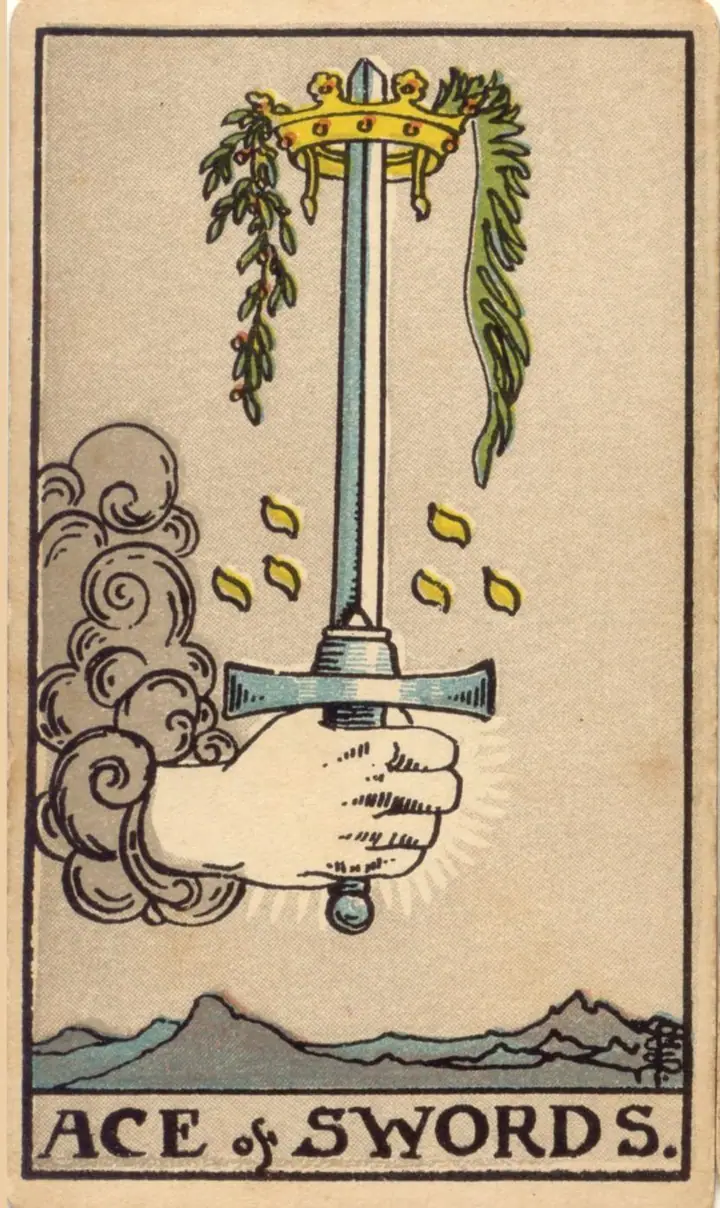

The scene on the Ace of Swords
A right hand emerges from a grey cloud, gripping a double-edged sword held straight up. The tip passes through a golden crown, from which hang an olive branch on one side and a palm frond on the other. Six small golden drops, like yods, fall through the air. Below lies a range of jagged, bare mountains, sharp against a pale sky.
Swords are the suit of air: thought, truth, words, decisions and conflict. The ace is the mind at its sharpest, a sudden moment of clarity.
The root of air
The Golden Dawn named the ace the Root of the Powers of Air. Astrologically the suit corresponds to the air signs, Gemini, Libra and Aquarius, which in Vedic terms are kama signs, the third, seventh and eleventh from the zodiac's start, associated with communication, relationships and aspirations. The olive branch and the palm are symbols of peace and victory: the sword cuts both ways, and clear thinking can bring either.
The Ace of Swords upright
Upright, the card brings a breakthrough: a new idea, a clear decision, the truth revealed, a solution found. It favours writing, study, legal clarity, honest conversations and any situation that requires sharp thinking. It often appears when confusion is about to lift.
It also asks for courage. Truth can cut, and the ace encourages you to speak plainly, but fairly, rather than staying silent to avoid discomfort.
The Ace of Swords reversed
Reversed, clarity is blocked or misused. You may be confused, misinformed or unable to decide. Sometimes the reversed ace shows harsh words, used as weapons rather than tools. The reversed card asks you to gather facts, think before speaking, and wait until the fog clears before cutting.
The Ace of Swords beside other cards
With Justice, a fair decision or legal clarity is likely. With the Page of Swords, new ideas and learning are emphasised. With the Three of Swords, a painful truth comes to light. In love readings, the card can describe a frank conversation that clears the air, or the need for honesty in a relationship. In work, it favours analysis, research, writing and decisive leadership.
Common misreadings of Ace of Swords
The Ace of Swords is sometimes taken as a sign of conflict, because swords suggest fighting. The crown and the olive and palm branches show that its edge is meant for clarity and justice. Its typical gifts are a diagnosis that finally explains symptoms, a contract clause that settles an ambiguity, an exam result, a frank conversation. A second misreading treats clarity as automatically pleasant. Truth that cuts through confusion can still hurt, and the jagged mountains below the sword suggest that the terrain ahead is not soft. The ace asks for honesty used carefully: say the true thing, but choose the moment and the words. Precision, not bluntness, is the skill being offered.
Working with the Ace of Swords
Take the question that has been circling in your mind and write it down as precisely as possible. Then write the simplest true answer you can find, without qualifying it. Often the clarity you seek is already there, hidden by too many words.
Clarity in everyday life
The ace often appears when life has become cluttered with half-decisions. Clearing a desk, finishing an overdue form, or saying a plain "no" to a request you have been dodging can give the same sense of release as a big revelation. The sword works at every scale.
Ace of Swords as a card of the day
As a card of the day, the Ace of Swords favours one clear decision or honest statement. Cut through a confusing situation by naming the main fact. Write, study or negotiate; your mind is sharp. Choose words carefully, because clarity can wound if delivered carelessly.
A question from the Ace of Swords
What truth do you already know that you need to say, at least to yourself?