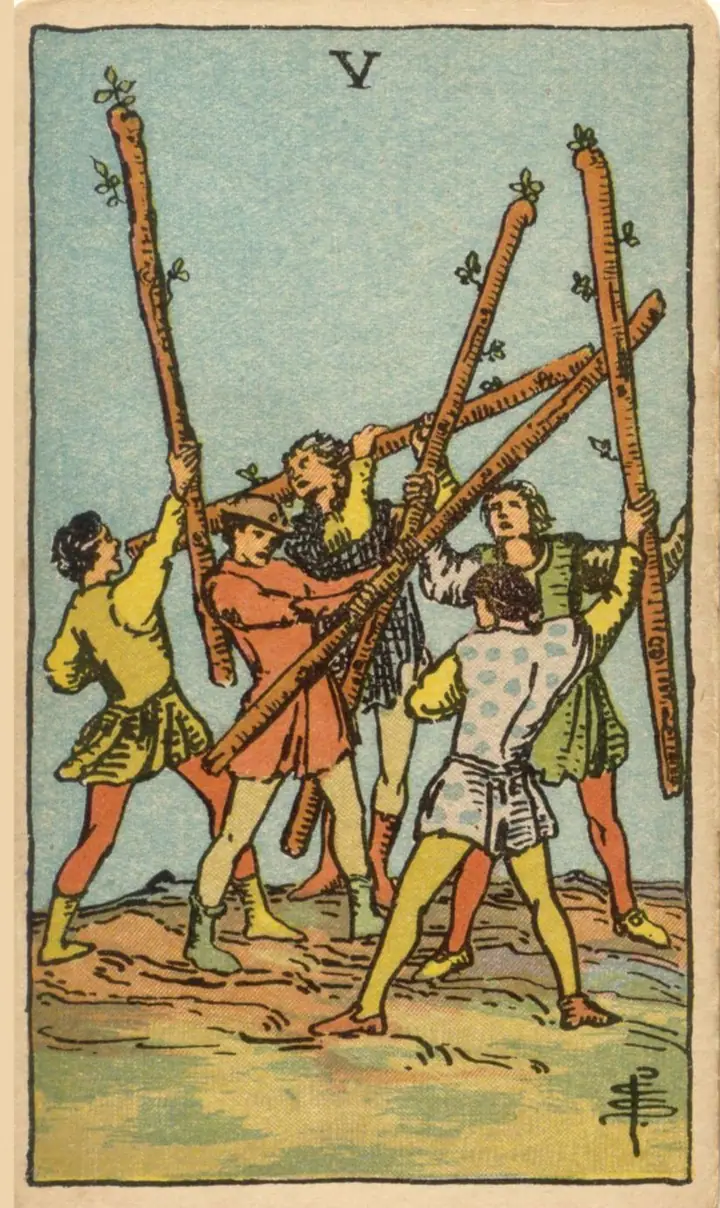

The scene on the Five of Wands
Five young men in different coloured tunics swing long wands at one another on rough, uneven ground. Each holds his staff differently: one raises it high, one braces it low, one seems to be blocking rather than striking. No one is hurt and no one is winning. It looks more like a game or a training exercise than a battle, a noisy scrum in which everyone is trying to be heard at once.
That is the heart of the card: friction rather than war, competition that may be healthy or merely exhausting, depending on how it is handled.
The Five of Wands in the Golden Dawn scheme
The Golden Dawn named this card the Lord of Strife and gave it to Saturn in Leo, the first decan of that sign. Saturn, planet of limits and duty, sits uneasily in the Sun's royal sign, and their natural enmity in Vedic astrology, where Shani and Surya are father and son at odds, mirrors the scene well. Leo wants to shine; Saturn insists on rules, waiting turns and earning a place. The squabble in the card is the sound of many egos meeting a structure that cannot give each of them the spotlight at once.
The Five of Wands upright
Upright, the card describes competition, debate and the friction of working with others. It may be a crowded job market, a team where everyone has an opinion, a family discussion where no one listens, or a sport or contest. It does not have to be negative. Competition sharpens skills, and debate tests ideas. The card simply asks you to recognise the scrum for what it is.
Its practical advice is to set ground rules. Who speaks when? What is the actual goal? Once a shared target is named, five people swinging staffs can become a team building something.
The Five of Wands reversed
Reversed, the conflict either escalates into something more serious or is avoided altogether. Sometimes it shows a quarrel finally settling down, people agreeing to disagree and getting on with the work. Sometimes it shows suppressed disagreement: everyone nodding in the meeting and complaining afterwards. Ask which is happening. Avoided conflict tends to return louder.
The Five of Wands beside other cards
With the Seven of Wands, you may need to defend your position firmly. With the Three of Pentacles, friction turns into productive teamwork. With the Five of Swords, the competition risks turning unkind and the card counsels restraint. In love readings it can describe arguments over small things, or a crowded field of admirers. In work, it describes competitive environments, pitches, negotiations and brainstorming sessions.
Common misreadings of Five of Wands
The Five of Wands is easily read as serious conflict. The young men are sparring, not wounding one another; the card describes friction, competition and many voices, which can be productive. Another misreading assumes the querent is the victim of others' aggression. Often they are one of the five, adding to the noise. The useful response is to find the common goal and set rules that let disagreement become collaboration.
Working with the Five of Wands
The next time you are caught in a heated discussion, pause and write down the point each person is actually trying to make. Often the five staffs turn out to be aiming at the same target from different angles. Naming that common target, aloud, is one of the quickest ways to turn noise into progress.
Five of Wands as a card of the day
On a day marked by the Five of Wands, expect lively disagreement: meetings with many opinions, family debates, competitive tasks. The advice is to keep it playful and focused. State the shared goal early, let everyone speak, and avoid turning ordinary friction into a feud. Sport or physical exercise is a good outlet for the energy.
A question from the Five of Wands
Is this conflict helping anyone improve, or just helping everyone be louder?