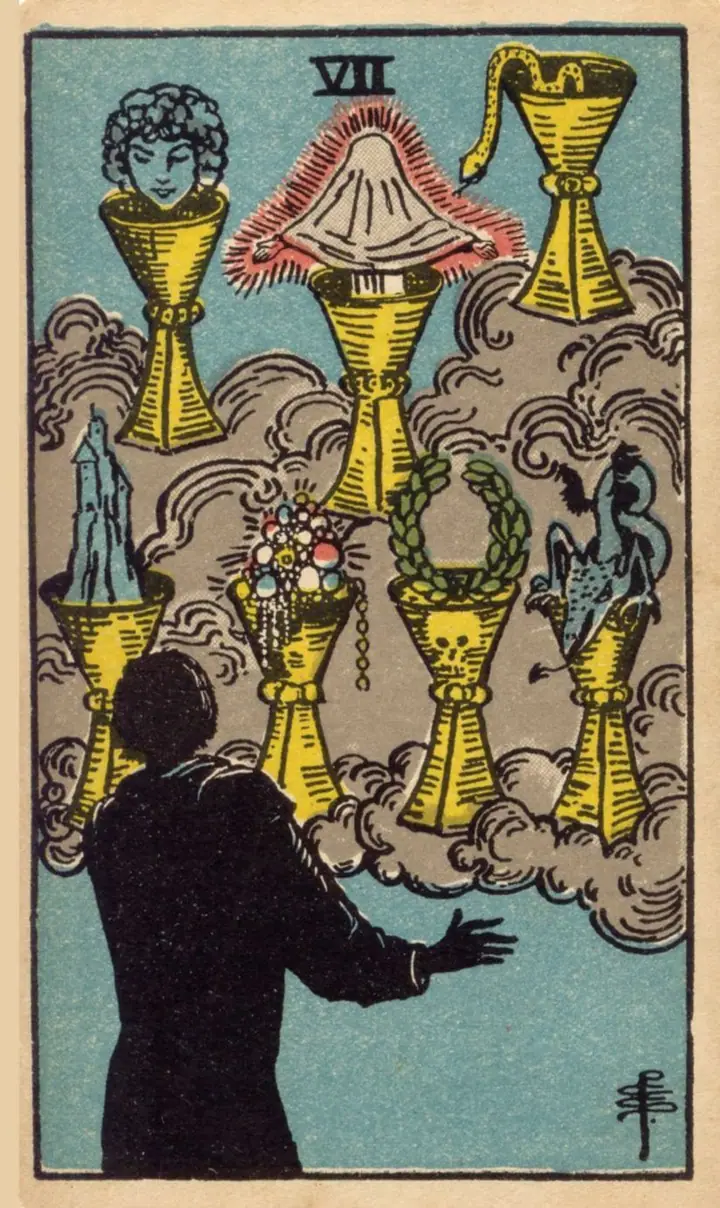

The scene on the Seven of Cups
A figure in dark silhouette stands with arms raised before seven cups floating in clouds. Each cup holds a different vision: a human head, a veiled glowing figure, a snake, a castle on a rock, a pile of jewels, a laurel wreath, and a dragon. Some are attractive, some unsettling, all of them unreal. The figure seems awed, perhaps bewildered, and is not reaching for any one in particular.
The card is about choices, imagination and the danger of wishful thinking.
The Seven of Cups in the Golden Dawn scheme
The Golden Dawn named it the Lord of Illusionary Success and placed it in the last decan of Scorpio, under Venus. Venus brings desire and imagination; Scorpio brings intensity and hidden depths. Together they produce visions that are powerful and seductive but not necessarily real. In Vedic astrology Venus in Vrischika is in the sign of a planet it regards as neutral, Mars, and the placement is often linked with strong, secretive desires. The cups float in clouds: dreams, not yet anchored in the ground.
The Seven of Cups upright
Upright, the card describes many options and a mind full of possibilities. That can be exciting, a time of imagination and creative brainstorming. But it also warns that not all options are real, and some are distractions or illusions. The card asks you to separate fantasy from viable plans. Which cup could you actually hold, and what would it take?
It can describe confusion about a decision, daydreaming instead of acting, or being swayed by appearances.
The Seven of Cups reversed
Reversed, clarity begins to emerge. You see which options are realistic, and you are ready to choose one. Sometimes it describes the opposite: becoming so overwhelmed by choices that you choose nothing at all, or a disappointment as a fantasy falls away. Either way, the reversed card encourages grounding: decide, and then commit.
The Seven of Cups beside other cards
With the Moon, the confusion is deep and decisions should wait for more information. With the Two of Swords, indecision is the central issue. With the Magician or the Eight of Pentacles, imagination can be turned into skilled work. In love readings, the card can describe idealising a partner or having several romantic possibilities. In work, it describes too many projects or ideas, and a need to prioritise.
Common misreadings of Seven of Cups
The Seven of Cups is easily read as a warning against dreaming. Imagination is necessary; every plan begins as a vision. The card's concern is choosing among visions without testing them. Some cups hold treasures, others snakes and dragons, and they all look shining from a distance. Another misreading is to treat the card as bad luck. It describes a mental state, many possibilities and little clarity, which can be resolved by gathering information and making one modest commitment. In relationships it can describe idealising someone; in work, too many projects at once. The remedy is the same: bring one vision down to earth and see whether it holds.
The Seven of Cups in hopes and fears, and in the Thoth deck
In the Celtic Cross, the ninth position is hopes and fears, and the Seven of Cups is almost made for it. The castle, the jewels and the laurel wreath stand for what a person hopes for; the snake, the dragon and the shrouded figure stand for what they dread. Often the two are entangled, as when someone wants recognition and fears the scrutiny that comes with it. When the card appears here, a reader can ask the querent to name which cup they keep looking at, and which they look away from. That simple sorting tends to show whether a fantasy or an anxiety is steering the decision.
As the outcome card, the Seven is gentler than its reputation. It rarely predicts disaster; more often it says the matter will remain open, with several options still in play, until one is actually chosen.
The Thoth deck by Crowley and Lady Frieda Harris calls the card Debauch and paints seven tarnished cups dripping a greenish liquid onto a stagnant sea, lotus flowers wilting above them. It is a far harsher image than Pamela Colman Smith's dreamlike clouds, and it names the risk plainly: appetite that has stopped asking whether its object is good for it. Seen beside the 1909 card, it is a reminder that endless options can turn sour if nothing is ever chosen.
Working with the Seven of Cups
Write each option on a separate card. For each, write the first three concrete steps you would take and the resources required. The cups that cannot be given three practical steps are probably clouds. The one with the clearest steps may be the one to pursue first.
Seven of Cups as a card of the day
The Seven of Cups as a card of the day warns against scattering energy. Daydream freely, then choose one realistic step toward one option.
A question from the Seven of Cups
Of all the visions in front of you, which one could you begin to build this month?