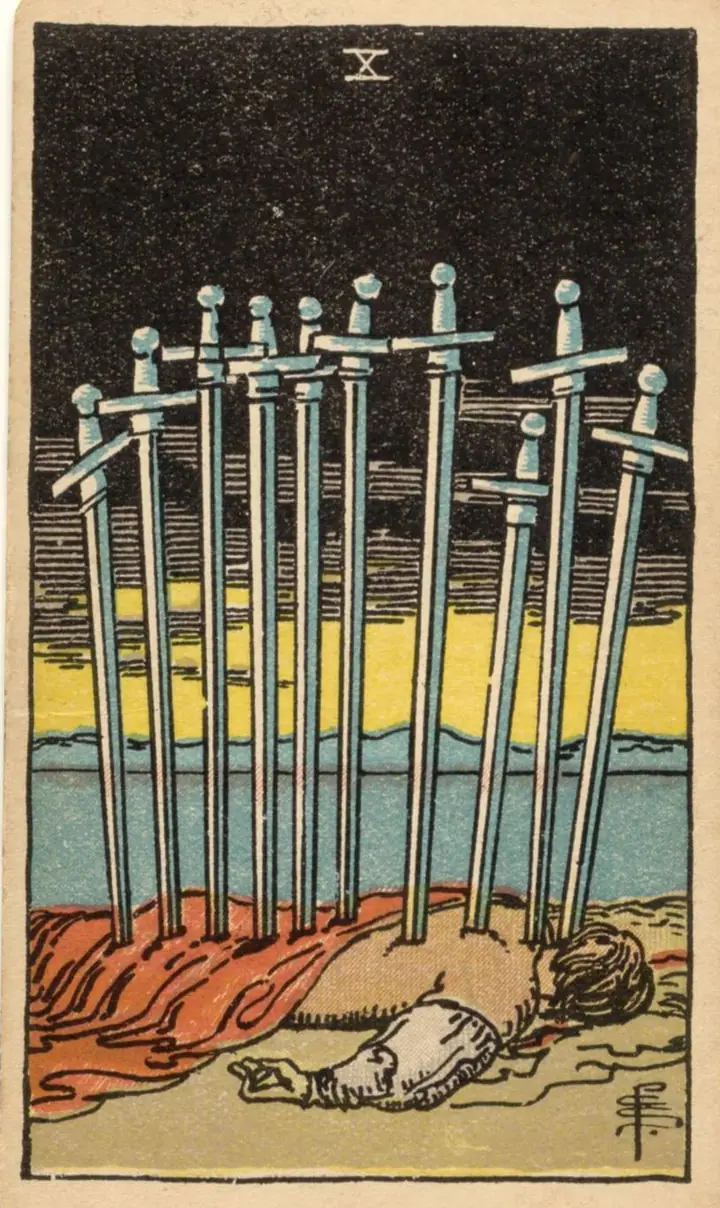

The scene on the Ten of Swords
A man lies face down on the shore with ten swords in his back, a red cloth draped over him. Above him the sky is black. But on the horizon, over calm water and distant hills, a bright yellow dawn is breaking. His right hand, visible beside him, makes a gesture of blessing, the same as the Hierophant's.
It is one of the most dramatic images in the deck, but it is also one of the most hopeful if you look at the horizon.
The Ten of Swords in the Golden Dawn scheme
The Golden Dawn named this card the Lord of Ruin and gave it to the Sun in Gemini, the last decan of the sign. The Sun's light in the mental sign of Gemini reveals everything, sometimes painfully. In Vedic astrology Surya in Mithuna sits in the sign of Mercury, a planet the Sun regards as neutral. The card's ruin is the end of an illusion, exposed by the Sun's light. And the Sun is also the dawn breaking on the horizon.
The Ten of Swords upright
Upright, the card describes an ending that feels final: a defeat, a betrayal, a collapse, or hitting rock bottom. It can be very painful. But the card's message is that this is the end of the story, not the middle. There are no more swords to fall. From here, the only way is up.
It encourages you to accept that something is over, rather than prolonging the pain by trying to revive it.
The Ten of Swords reversed
Reversed, recovery begins. The worst is over, and you start to stand up. Sometimes it shows resistance to an ending, refusing to accept what has happened. The reversed card encourages acceptance and gradual rebuilding.
The Ten of Swords beside other cards
With Death or the Tower, a major ending is emphasised. With the Star or the Sun, recovery is close. With the Five of Cups, grief over what is lost is strong. In love readings, the card can describe the painful end of a relationship, but also the relief of finally letting go. In work, it can describe a job loss or failed project that leads to something better.
Common misreadings of Ten of Swords
Few cards look as dramatic as the Ten of Swords, and readers sometimes respond with alarm. Its traditional meaning is the end of something, the bottom of a cycle, not physical harm. The ten swords are an exaggeration on purpose: there is nothing more to lose here. The yellow dawn and the calm water point to what comes next. Another misreading ignores the hand. The figure's hand is raised in a gesture of blessing, like the Hierophant's. Even at the lowest point, something in the person remains intact. The card often appears for people who are finally accepting that a situation is over, which, painful as it is, is the moment recovery can begin.
Working with the Ten of Swords
If you are at a low point, be gentle with yourself. Rest, seek support, and do not make major decisions in the darkest hour. When you are ready, look for the dawn: one small thing that is already improving, one person who cares, one possibility that remains.
The blessing in the hand
The raised hand, often overlooked, suggests that even at the lowest point something sacred remains in the person. Readers who notice it tend to treat the card not as a verdict on a life but as the closing of one difficult chapter, after which the person stands up changed and often wiser.
Ten of Swords as a card of the day
On a Ten of Swords day, accept that something has ended. Do not try to revive it. Rest, gather support and look for the first small sign of dawn, an offer, an idea, a kind word.
A question from the Ten of Swords
If this is truly the end of a painful chapter, what might the dawn bring?