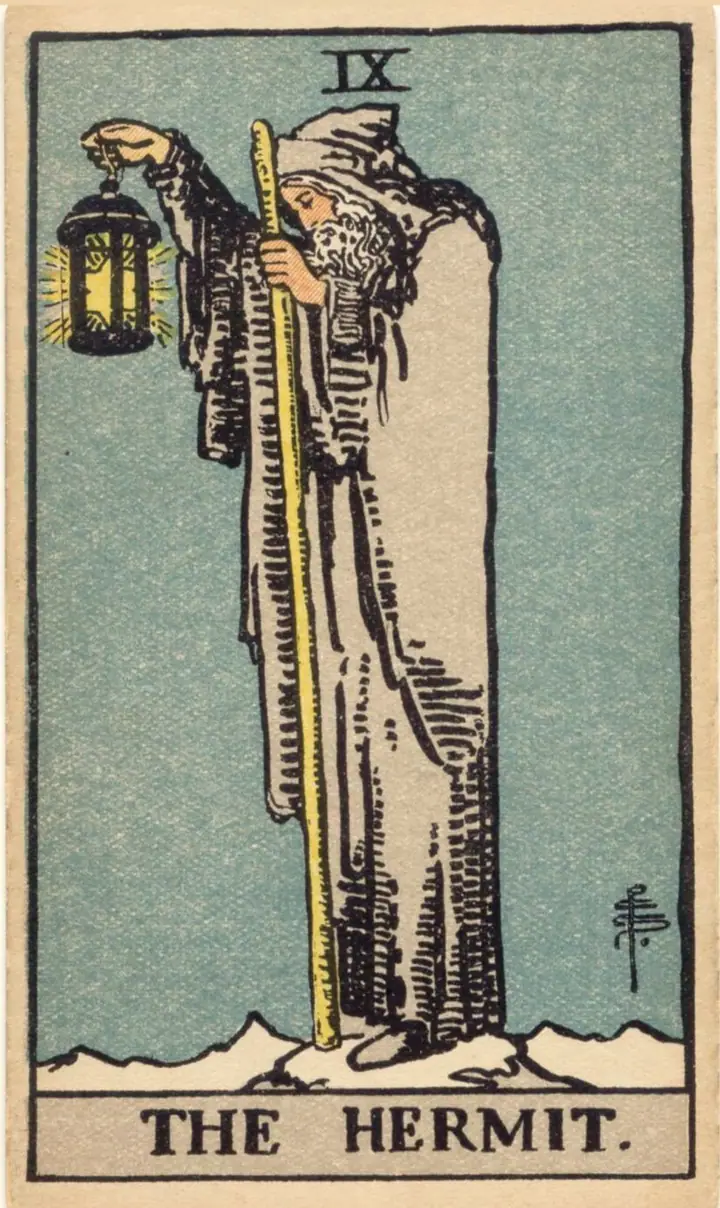

The picture on The Hermit
An old man in a hooded grey cloak stands alone on a snowy summit at night. He holds up a lantern in which shines a six-pointed star, and leans on a long staff. His head is bowed, his eyes nearly closed; he is not looking far ahead, only at the next step the lantern lights. Below him, presumably, are the paths of others, who may see his lamp from far off.
The Hermit has climbed away from the crowd not to escape it, but to see clearly. His light is for himself first and then for anyone who follows.
Number nine and Virgo
Nine is the last single digit, a number of completion and wisdom gathered. The Golden Dawn gave the Hermit to Virgo, the earth sign ruled by Mercury, careful, analytical, devoted to getting the details right. Virgo is also the sign of the harvest maiden, of service and of health. In Jyotish, Kanya is the sign where Mercury is exalted: discernment at its sharpest. The Hermit's lamp is that discernment, a steady light that shows things as they are rather than as we wish them to be.
The Hermit upright
Upright, the card recommends withdrawal for a purpose. Step back from noise and opinion and think for yourself. This may mean a retreat, a period of study, a solo trip, time away from social media, or simply evenings kept free. The Hermit appears when an answer will not come from asking more people; it will come from sitting with the question.
It also describes mentors: the teacher who speaks rarely but well, the elder whose advice is worth the climb. You may be looking for such a person, or becoming one.
The Hermit reversed
Reversed, solitude turns into isolation. The retreat has gone on too long, or it was never chosen; loneliness is passing itself off as independence. Another reversed meaning is resistance to reflection: staying busy so as not to face what the quiet would reveal. The correction depends on which is true. Either come down the mountain and talk to someone, or book the quiet hour you have been avoiding.
The Hermit beside other cards
With the High Priestess, the Hermit doubles the call for inner listening. With the Four of Swords it points to rest and recovery. In relationship readings it may show a partner who needs space, or a phase of being single that serves growth. In work readings it favours research, writing, specialist expertise and roles that reward depth over visibility.
Common misreadings of The Hermit
The Hermit is often taken to mean loneliness or a long period without a partner. It can describe a phase of being single, but its emphasis is on chosen reflection rather than rejection. Many people draw it when the most important relationship to attend to is the one with their own judgement.
Working with The Hermit
Block a regular solitary hour each week for a month: no phone, no input, just a notebook and the question. At the end of each session write one sentence you now believe. After four weeks you will usually find the sentences have quietly converged on an answer.
The Hermit as a card of the day
On a Hermit day, take time alone to think. Reduce input, walk, reflect, and seek counsel from one wise person rather than many.
A question from The Hermit
What would you hear if everyone else, for a while, stopped talking?