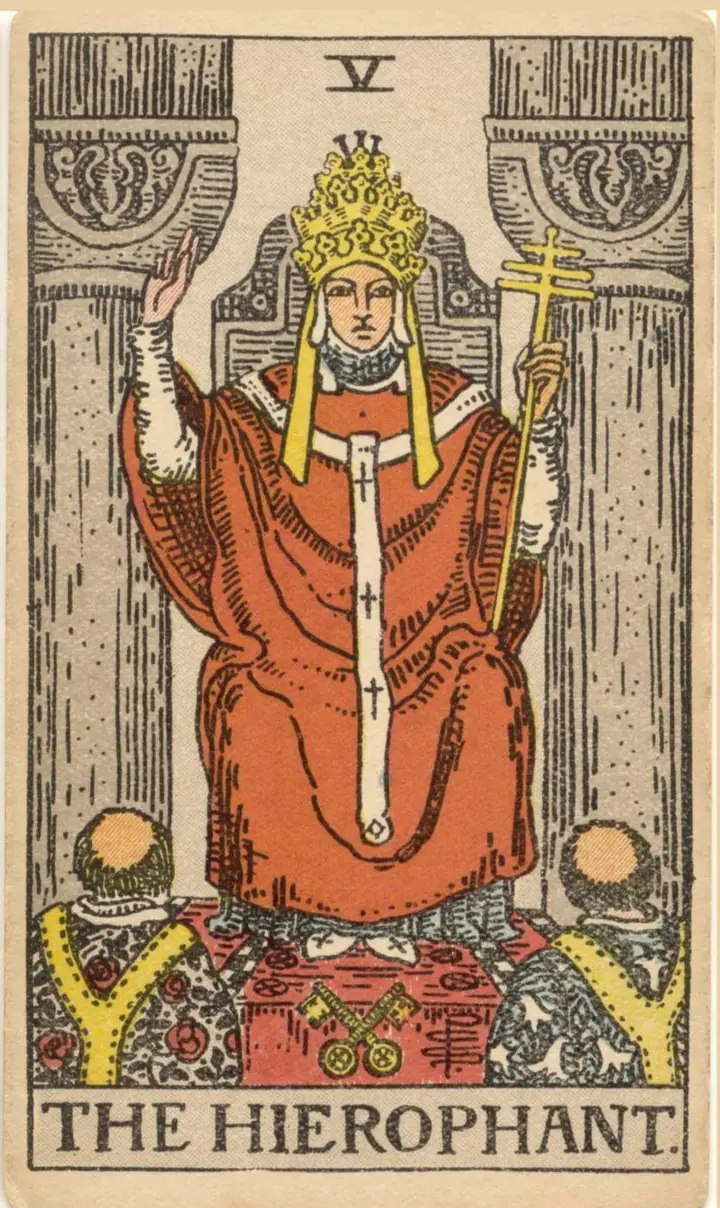

The picture on The Hierophant
The Hierophant sits between two grey pillars, like the High Priestess, but his space is public. He wears a triple crown and red robes, raises his right hand in blessing, and holds a triple cross in his left. Before him kneel two tonsured monks, one robed in roses and one in lilies, and at his feet lie two crossed keys. The keys are the image to remember: knowledge that opens doors, held in trust and handed on.
Where the Priestess keeps inner wisdom, the Hierophant teaches outer forms: rituals, scriptures, lineages, schools.
Number five and Taurus
Five breaks the stability of four by adding something new: in this case, the voice of the teacher between people and the sacred. The Golden Dawn gave the card to Taurus, the fixed earth sign ruled by Venus, in which the Moon is exalted. Taurus values what lasts, what has been proven, what is passed down through families. In a Vedic context the card could equally stand for the guru, the acharya or the family priest who performs the rites as they have always been performed.
The Hierophant upright
Upright, the Hierophant favours learning from an established source. Enrol in the course, find the teacher, read the classic text rather than the summary, follow the method that has worked for others before inventing your own. It often appears around formal commitments such as marriage ceremonies, graduations, initiations or joining an organisation, where the form of the occasion carries meaning.
It also speaks for shared values. A community that keeps traditions can hold people through hard times, and the card reminds you that you do not have to work everything out alone.
The Hierophant reversed
Reversed, the card questions the tradition rather than rejecting it outright. A rule may be followed only because it always has been. A teacher may demand obedience without offering understanding. Or you may be outgrowing a framework that once fitted well. The honest work is to separate the living core of a practice from the habits that have grown around it, keeping the first and letting the second go.
The Hierophant beside other cards
With the Lovers, the Hierophant can describe a formal marriage or a choice made within family expectations. With the Page of Pentacles it is a strong card for study and qualifications. In work readings it points to institutions such as universities, temples, banks, large firms and professional bodies, and to roles as mentor or student. Two keys suggest two people: someone who knows, and someone ready to learn.
Common misreadings of The Hierophant
Some modern readers treat the Hierophant as purely negative, a symbol of rigid institutions. That misses half the card. Traditions carry hard-won knowledge, and a good teacher saves years of trial and error. The card asks for discernment about forms, not contempt for them.
Working with The Hierophant
Name one person whose way of doing things you admire, and ask them how they learned it. Most skilled people are glad to explain. Alternatively, return to a practice you were taught as a child, with adult attention, and see what you understand now that you missed then.
The Hierophant as a card of the day
On a Hierophant day, learn from tradition or a teacher. Attend a class, consult an expert, or return to a practice that has served you before. Formal occasions go well.
A question from The Hierophant
Which traditions in your life still nourish you, and which are you keeping only out of habit?