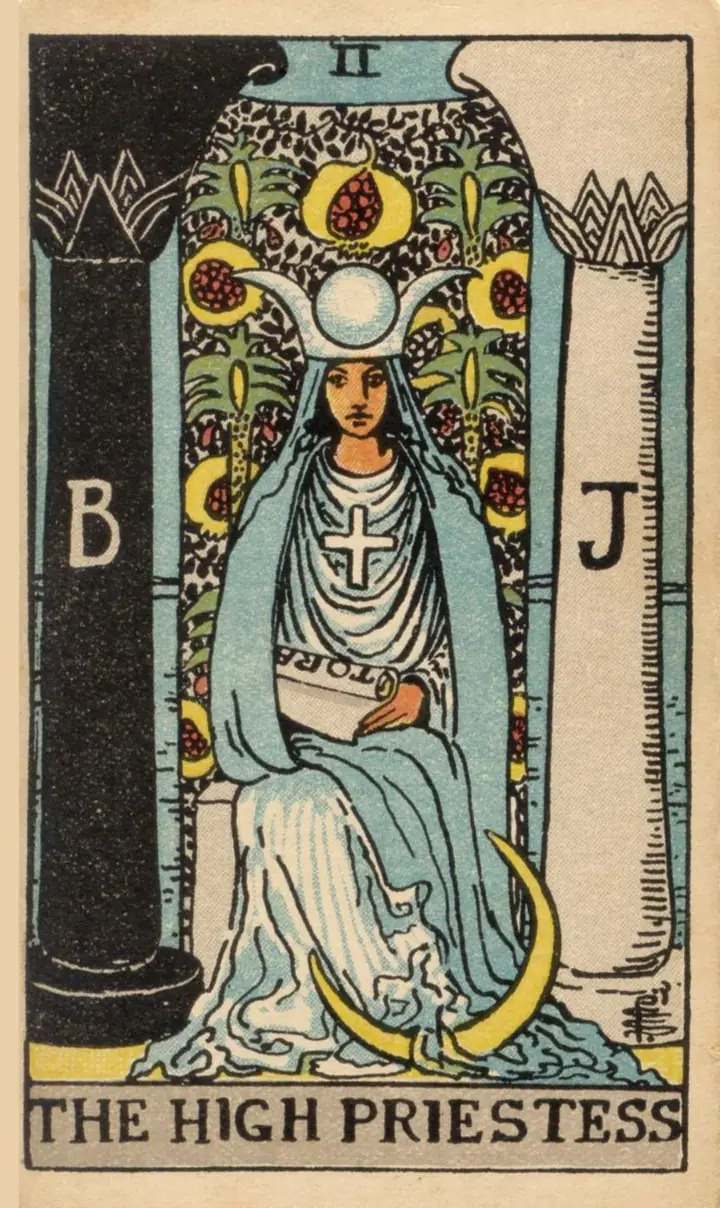

The picture on The High Priestess
The High Priestess sits very still between two pillars, one black and one white, marked B and J for Boaz and Jachin, the pillars of Solomon's temple. Behind her hangs a veil embroidered with pomegranates, and through the gaps you can glimpse water. She holds a partly hidden scroll marked TORA. A crescent moon rests at her feet, and her headdress carries the moon in its phases. Her robe flows down like water into the bottom of the card.
She does not act or point. She keeps. The card is about the kind of knowledge that cannot be hurried: what you sense before you can prove it.
Number two and the Moon
Two is the first pair, and the pillars make that visible: light and dark, known and unknown, with the Priestess seated at the threshold. The Golden Dawn gave this card to the Moon. In Jyotish, too, Chandra rules the mind's moods, memory and receptivity, and the Moon's light is reflected rather than its own. That is a useful image for the card: insight that arrives when you are quiet enough to reflect it.
The High Priestess upright
Upright, the High Priestess asks you to wait, listen and notice before deciding. Something in the situation is not yet visible. You may already sense it. The card does not tell you to act on hunches blindly; it tells you not to override them for the sake of looking decisive. Sleep on it. Keep a note of dreams, recurring thoughts, or the small details that make you uneasy or hopeful.
In study and spiritual practice the card favours depth over speed: reading the original text, sitting in silence, learning from a teacher who says little.
The High Priestess reversed
Reversed, the inner voice is either drowned out or ignored. Too much noise, too many opinions, too much scrolling. Sometimes the reversed Priestess points to secrets kept for the wrong reasons, or to a person who uses mystery as power. The correction is simple in principle: reduce input, then ask yourself what you already know but have not admitted.
The High Priestess beside other cards
Next to the Magician, she shows the balance between action and receptivity; the two cards are often read as a pair. In a love reading she can describe unspoken feelings or a relationship whose depth is not yet shown in public. In a work reading she favours research, confidential matters, counselling and any role where discretion is the skill.
Common misreadings of The High Priestess
People sometimes read the Priestess as a sign of a secret lover or hidden enemy. That is rarely useful. Her secret is usually your own unacknowledged knowledge, and the card is far more often about listening than about intrigue. Nor is she simply passive: choosing not to act yet is itself a decision, and often the wisest available.
Working with The High Priestess
Give the question a fixed waiting period, such as three nights, before you answer it. Write down your first instinct now and seal it away, then compare it with what you think once the period ends. Notice which details kept returning. People often find that the first instinct was right but incomplete, and that the waiting supplied the missing piece. If someone is pressing you for a quick decision, the Priestess allows you to say that you need time, without apology and without long explanations.
A question from The High Priestess
What do you know about this situation that you have not yet said out loud, even to yourself?