
The scene on the Two of Cups
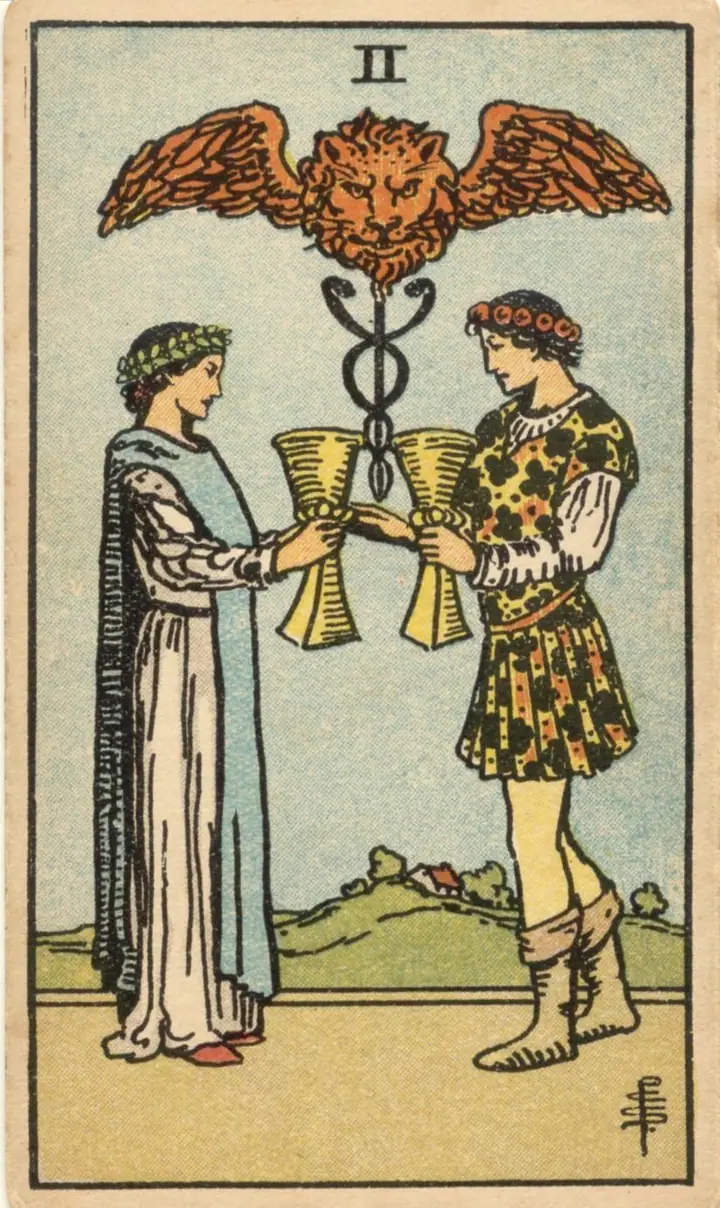
A young man and a young woman stand facing each other, each holding a cup. He reaches toward her cup; she holds hers steadily. Both wear garlands. Between them rises a caduceus, the staff of Hermes with two serpents twined around it, and above it a winged lion's head. Behind them stand a house on a hill and green countryside. The scene feels like a pledge or an exchange of vows.
The card is about meeting someone as an equal, with something to give and something to receive.
The Two of Cups in the Golden Dawn scheme
The Golden Dawn named this card the Lord of Love and gave it to Venus in Cancer, the first decan of the sign. Venus, planet of attraction and harmony, in the Moon's sign of home and care, produces a love that is tender, protective and sincere. In Vedic astrology Venus in Karka is in an enemy's sign by natural friendships, since Shukra does not count the Moon a friend, yet the combination is often linked with emotional sensitivity and devotion. The caduceus between the couple, a healing symbol, suggests that this union restores both people.
The Two of Cups upright
Upright, the card describes a meaningful connection between two people: romance, friendship, a business partnership or reconciliation after a quarrel. It emphasises mutuality. Both people are giving and both are receiving, neither is dominating. It favours engagements, new relationships built on respect, and partnerships founded on shared values.
It also speaks of attraction in its fullest sense, the recognition of someone whose presence makes you feel more yourself.
The Two of Cups reversed
Reversed, the balance is off. One person gives more than the other, communication breaks down, or a partnership loses its spark. Sometimes it shows a separation, or a misunderstanding that needs to be cleared. The reversed card asks for honest conversation. Mutuality is rebuilt by small exchanges: listening, apologising, offering.
The Two of Cups beside other cards
With the Lovers, the connection is very strong and points toward commitment. With the Four of Wands, a celebration such as an engagement or wedding is likely. With the Three of Swords, the bond is going through pain and needs care. In work, the card favours partnerships, collaborations and negotiations where both sides benefit. In friendship, it describes a bond of trust.
Common misreadings of Two of Cups
The Two of Cups is frequently read as a promise of soulmate love. It describes mutual recognition and equal exchange, which can begin a romance but also a friendship, a business partnership or a reconciliation. Assuming it must mean marriage overlooks the many other bonds it fits. Another misreading forgets the caduceus between the figures, a symbol of healing and negotiation. The card is about two people working out terms, not only feelings. When it appears, the useful question is whether the exchange is genuinely balanced: are both people giving, and both receiving? If one cup is fuller than the other, the card asks for a conversation before resentment grows.
A worked three-card reading with the Two of Cups
Suppose someone asks about a business partnership that a former classmate has proposed. Three cards are laid for past, present and next step: the Eight of Wands, the Two of Cups, and the Four of Pentacles.
The Eight of Wands in the first place describes how the idea arrived: fast, through a flurry of messages, with enthusiasm running ahead of detail. In the centre, the Two of Cups says the present feeling between the two people is mutual and warm. Neither is courting the other from a position of need, and the caduceus between the figures hints that the arrangement could be good for both.
The third card complicates the picture. The Four of Pentacles is a figure clutching coins, and as the next step it suggests that money is about to become the real subject. Fondness alone will not settle who invests what, or who keeps the client list if it ends.
Read together, the cards do not say yes or no. They say that the goodwill is genuine and should be used, now, to have the uncomfortable conversation about shares, roles and an exit clause while both people still feel generous. In this reading the Two of Cups is less a romance than a moment of trust, and trust is easiest to put into writing while it is fresh.
Working with the Two of Cups
Think of one relationship that matters to you and ask: what do I give here, and what do I receive? Write both lists honestly. If either is short, have a conversation about it, gently and without accusation. Two cups are held evenly only when both people know what is being exchanged.
Two of Cups as a card of the day
On a Two of Cups day, connect one-to-one. Meet a friend, partner or colleague and listen as carefully as you speak. Agreements and reconciliations go well. Balance giving and receiving.
A question from the Two of Cups
Who in your life meets you as an equal, and how do you honour that?