Video
6th House in Vedic Astrology: Debt, Disease, Rivals & Service (Ripu Bhava Explained)
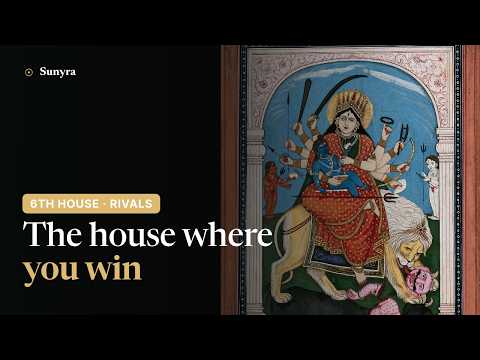
Plays from YouTube (privacy-enhanced mode) when you press play.
The 6th house in Vedic and Western astrology: debt, disease, rivals, service, daily work and routine. What the 6th house means (ripu and roga bhava; its Sanskrit names; Mars and Saturn as significators), why it is both a difficult house and a growth house (upachaya), the 6th lord and Harsha yoga (a viparita raja yoga), every planet in the 6th house and why the malefics are strong there, health as association and never diagnosis, and when the 6th house comes alive.
This video belongs with The Sixth House in Astrology: Work, Health, Service and Rivals, which has the full explanation and its classical sources.
Chapters
- 0:00 The house of the fight
- 0:46 What the sixth house means
- 1:23 A difficult house that grows
- 2:17 Where the struggle goes
- 2:53 Planets in the sixth house
- 3:56 Health, and when it comes alive
- 4:50 Recap
- 5:36 Sunyra Lens, November
Transcript
The house of the fight
Every life has its battles. Debts to repay, illness to recover from, rivals at work, the daily grind of service. Vedic astrology gives all of them one house, the sixth. And then it says something surprising: this is also the house where you win. The sixth house is called ripu bhava, the house of enemies, and roga bhava, the house of illness.
In this video: what the sixth house means, why it is both a difficult house and a growth house, where its lord sends the struggle, which planets are strongest here, how to think about health carefully, and when the sixth house comes alive.
What the sixth house means
The classical texts give the sixth house enemies, illness, injuries, debts, maternal relatives, servants, and obstacles. Its Sanskrit names say it all: Ripu, enemies; Roga, illness; Rina, debt; and Seva, service. Its significators are Mars and Saturn. In the West, the Hellenistic astrologers called the sixth place Bad Fortune. Modern Western astrology reads it more gently: daily work and routine, health habits, service, colleagues, and pets.
A difficult house that grows
Here is the key to the sixth house. It is a dusthana, a difficult house, with the eighth and twelfth. But it is also an upachaya, a growth house, with the third, tenth and eleventh. In an upachaya, results improve with time and effort. So the sixth describes the problems life brings, illness, conflict and debt, and also the capacity to meet them: discipline, service, competition and healing.
Many doctors, lawyers, soldiers, nurses and athletes have strong sixth houses. Its difficulties are classically expected to lessen with age and effort. A chart with a heavy sixth house is not a chart of misfortune. It is often the chart of someone who becomes very good at solving problems.
Where the struggle goes
The lord of the sixth house carries its themes wherever it goes. In the tenth, it can describe a career of service, competition or healing. In the first, a competitive, hard-working temperament. In the seventh, conflicts, or practical work with partners. And in the twelfth, another difficult house, it forms Harsha yoga, one of the three viparita raja yogas, in which the lord of a difficult house, placed in another difficult house, turns trouble into eventual gain.
Planets in the sixth house
Now the planets in the sixth house. Here the usual rules turn around. The natural malefics are traditionally strong in the sixth. Mars is a classic strong placement: courage, competitive success, power over obstacles. Saturn, a co-significator, gives endurance, disciplined service, and victory over rivals with time.
Rahu, overcoming competitors by unconventional means. The Sun, strength against rivals, and authority at work. Ketu, sharp, precise work, and detachment from disputes. The gentler planets are less at ease. Mercury gives analytical work and problem-solving.
The Moon, emotional involvement in care, and often a caring profession. Jupiter, service guided by ethics, though classical texts are mixed about a benefic here. And Venus, a pleasant workplace, but less comfort in a house of struggle.
Health, and when it comes alive
A careful word on health. The sixth is the traditional house of illness, and Sunyra describes this only as traditional association. No chart diagnoses illness, and no astrological reading should delay or replace medical care. What the sixth house can usefully describe is your relationship with routine, health habits, and work-life balance. The sixth house comes to the foreground in the dasha of its lord, of planets placed in it, and of Mars and Saturn.
Such periods are traditionally linked with hard work, competition, legal matters, loans taken or repaid, and new service roles. They are often remembered as demanding, and as the periods in which a person proved what they could overcome.
Recap
To recap. The sixth house is enemies, illness, debt and service. It is a difficult house and a growth house: problems arise there, and are overcome there with effort. Mars and Saturn are its significators, and the malefics are strong here. Its lord in the twelfth forms Harsha yoga.
And it is never a diagnosis. To see your sixth house and its lord, make a free kundli on sunyra.ai. And if you would like your working life read in depth, the work that suits you and the years your career rises, Sunyra's Career and Wealth report on sunyra.ai does that, from your own birth details.
Sunyra Lens, November
One more thing before you go. Our free November Lens is on sunyra.ai slash lens. It has a day-by-day panchang for all thirty days, a two-page November for each of the twelve Moon signs, and My November, a free calendar read from your own chart. The wedding season has begun, and Lens shows what to look at in your chart, and what not to fear. Thank you for watching.
May every battle you face leave you stronger than before.
Astrology is a tradition of interpretation; read this as guidance, not a forecast. Disclaimer.