Short
Aarti Kunj Bihari Ki: what the Krishna aarti means
Plays from YouTube (privacy-enhanced mode) when you press play.
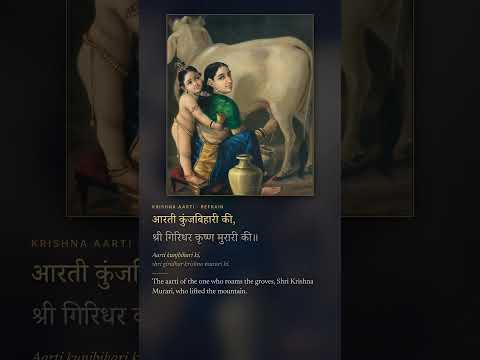
The refrain of the Krishna aarti, Aarti Kunj Bihari Ki, with its meaning in English.
Two lines, five names for one boy
The refrain is almost a list of titles strung on the little word ki, “of”. Aarti is the ceremony of the lamp, from the Sanskrit aratrika, waved before a deity at the close of worship. Kunj is a grove or bower of creepers; bihari, from the Sanskrit vihari, is one who roams, strolls or plays. Shri is an honorific. Giridhar joins giri, mountain, with dhar, holder. Krishna means “the dark one”, and Murari is Mura plus ari, the foe of Mura.
So the line says, quite literally: this is the lamp-offering of the one who wanders the groves, the honoured mountain-holder, Krishna, enemy of Mura. Each name opens onto a story, and the aarti expects singers to know them.
Kunj: the bowers of Braj
The groves in question are those of Vrindavan and the wider Braj country along the Yamuna, south of Delhi. In devotional poetry the kunj is where Krishna herds cows by day and meets Radha and the gopis at dusk; the inner bower, the nikunj, becomes a symbol of intimate love between the soul and God. To call Krishna Kunj Bihari is to recall him not as a king or a teacher but as the playful youth of those forests.
Everything else in the aarti follows from that choice. Its verses linger over a vaijayanti garland, a flute, a peacock crown, sand glinting on the riverbank. It is a portrait in words, painted while the flame circles the image.
Giridhar: the hill held up
The Bhagavata Purana (book 10, chapters 24 and 25) tells how the cowherds of Braj were preparing their yearly offering to Indra, god of rain. The young Krishna persuaded them to honour instead Govardhan, the hill that fed their cattle. Indra, offended, sent days of storm. Krishna raised the whole hill and held it aloft like an umbrella, and the villagers sheltered beneath it with their herds until the rain stopped; popular retellings say he used only his little finger.
Govardhan Puja, the day after Diwali in much of North India, keeps this memory alive. In the aarti the name works as a quiet reassurance: the one being praised is the one who shelters.
Murari: protector against Mura
Mura was a many-headed demon who guarded the fortress of Naraka, an oppressor of gods and humans. In the Bhagavata's account (10.59) Krishna, riding Garuda with Satyabhama, broke through the defences and cut Mura down with his discus before overcoming Naraka himself and freeing the women held captive there. The epithet Murari carries that whole episode. Joined to Giridhar, it gives the refrain two complementary pictures of care: holding up a shelter, and removing a threat.
How the refrain is used, and how to say it
This couplet is sung first and then returns after every verse, while the five verses each finish on “shri giridhar krishna murari ki”, so the second half is heard again and again. Families wave the lamp slowly clockwise during the singing, and in Braj the aarti is especially associated with midnight on Janmashtami, when the birth is celebrated, as well as ordinary evenings in homes that keep a Laddu Gopal image.
Pronounce it: aar-tee koonj-bi-haa-ree kee, shree gi-ri-dhur krish-nuh mu-raa-ree kee. The dh in giridhar is breathy; the r in Krishna is a quick tap. Braj Hindi keeps the vowels open and unhurried, so the refrain is easy to join even for someone hearing it for the first time. No knowledge of the stories is required to sing, though knowing them makes each name glow a little brighter.
A word on the dialect: ki is the Braj and Hindi possessive, so every line of the refrain is grammatically incomplete on its own, a string of “of the one who…” phrases. The missing noun is the lamp itself. Each time the refrain returns, it is as if the singers point once more at the flame and say whose it is.
Sources: Bhagavata Purana, book 10, tr. Edwin F. Bryant, Krishna: The Beautiful Legend of God (Penguin Classics, 2003) · Aarti Kunj Bihari Ki, traditional Braj aarti, author unknown; text as in Drik Panchang and the Arati Sangrah of sanskritdocuments.org
Transcript
The aarti of the one who roams the groves, Shri Krishna Murari, who lifted the mountain. The aarti of the one who roams the groves, Shri Krishna Murari, who lifted the mountain.
Astrology is a tradition of interpretation; read this as guidance, not a forecast. Disclaimer.