Short
December new Moon 2026: Amavasya 8 Dec, in Jyeshtha
Plays from YouTube (privacy-enhanced mode) when you press play.
Amavasya holds Tue 8 Dec 2026; the Moon is exactly new at 06:21 IST on 9 Dec in Scorpio, Jyeshtha. It opens the fortnight of Saturn direct, Jupiter retrograde and Kharmas.
This video belongs with Jyeshtha Nakshatra: Meaning, Deity, Traits and Padas, which has the full explanation and its classical sources.
The times, and reading them abroad
Computed for New Delhi, the Amavasya tithi of December 2026 begins at 04:13 IST on Tuesday 8 December, before sunrise, and ends at 06:21 IST on Wednesday 9 December, which is also the instant of the exact conjunction of Sun and Moon. Since the tithi is already running at Tuesday's dawn and finishes just before Wednesday's, the 8th is the Amavasya day in India.
In universal time the tithi runs from 22:43 UTC on 7 December to 00:51 UTC on 9 December. Readers in the Americas will therefore see the exact new Moon on the evening of the 8th by their own clocks, while in East Asia and Australia it falls on the morning of the 9th. Local panchangs, built on local sunrise, may assign the day differently, and they are the right guide for observance.
Two calendars, one sky
Hindu lunar months are counted in two ways. In the amanta system, used across much of the south and west of India and by many communities abroad, each month closes at a new Moon, so this conjunction opens Margashirsha. In the purnimanta system of the north, months close at the full Moon; Margashirsha there began after Kartik Purnima on 24 November, and this is its dark fortnight's end. The festivals line up the same way in both systems once the counting is understood.
Jyeshtha and the burden of the eldest
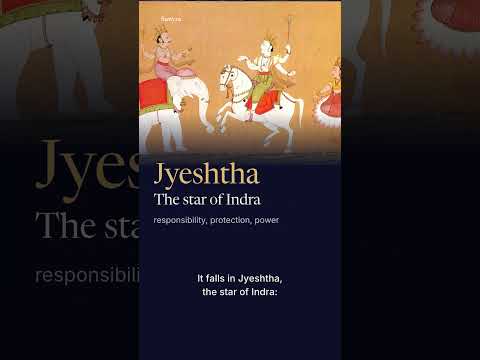
The conjunction falls at 22.7° of sidereal Scorpio, inside Jyeshtha, the eighteenth nakshatra, which covers 16°40′ to 30° of the sign. Jyeshtha means the eldest or most senior. Its deity is Indra, its Vimshottari lord Mercury, and its traditional star Antares, the reddish heart of the Scorpion. The symbol is an amulet or a parasol, the cover a senior person holds over those in their care.
Indra's story carries both sides of seniority. In Rigveda 1.32 he kills the serpent Vritra and frees the rivers; in the Bhagavata Purana he sends a storm on the cowherds of Vraja when they stop honouring him, and Krishna shelters them under Mount Govardhana until Indra relents. Jyeshtha therefore speaks of courage and protection, and also of pride and the loneliness of command. Muhurta texts count it among the sharp nakshatras, suited to ending and clearing rather than to celebrations.
The planets around the conjunction
The Moon is debilitated in Scorpio, and Brihat Parashara Hora Shastra places its lowest point at 3° of the sign; at 22.7° it is well past that point but still in its sign of fall. Combined with a Mercury hidden in the Sun's rays and Mars throwing its fourth-sign aspect from Leo, the picture is of an intense and private new Moon rather than a buoyant one. Neither Jupiter nor Saturn aspects Scorpio. Rahu and Ketu shifted into Capricorn and Cancer three days earlier, too far from the luminaries for an eclipse.
Practically, a mood like this suits finishing a task long avoided, accepting a responsibility, or quiet research, more than launching something new.
The fortnight that follows
The waxing fortnight after this Amavasya is crowded. Saturn resumes direct motion on 11 December and Jupiter turns retrograde on the 13th. On the 16th the Sun crosses into Sagittarius, which begins Kharmas, the month many families avoid for weddings. Mokshada Ekadashi, also observed as Gita Jayanti, follows on the 20th, and the fortnight closes with the full Moon in Ardra on the 23rd and 24th.
The tradition keeps Amavasya itself for rest, prayer and remembrance of ancestors, and leaves major beginnings to the brighter days. To find which part of your life this new Moon touches, count from your Moon sign to Scorpio; a Libra Moon, for instance, meets it in the second house of money and speech. Any timing for you comes from your own dashas and transits.
Sources: Brihat Parashara Hora Shastra, ch. 3 (the Moon's debilitation), tr. R. Santhanam · Rigveda 1.32 (Indra and Vritra) · Bhagavata Purana 10.24–10.25 (Govardhana)
Transcript
The last new Moon before the slow planets turn. Amavasya holds the whole of Tuesday, the eighth of December, and the Moon is exactly new early on the ninth, in Scorpio. It falls in Jyeshtha, the star of Indra: the eldest, the protector, the one who carries responsibility. And it opens a busy fortnight. Saturn turns direct on the eleventh, Jupiter turns retrograde on the thirteenth, and Kharmas begins on the sixteenth.
Find where it falls for you with a free kundli at sunyra.ai.
Astrology is a tradition of interpretation; read this as guidance, not a forecast. Disclaimer.