Short
Maha Mrityunjaya Mantra: what it really means
Plays from YouTube (privacy-enhanced mode) when you press play.
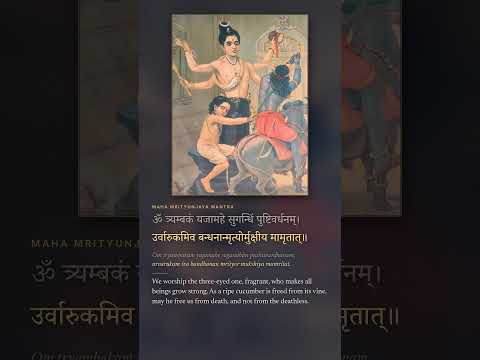
Om Tryambakam Yajamahe: the Maha Mrityunjaya Mantra of the Rig Veda, with its meaning in English. Read the mantra word by word
Eleven words, in order
Tryambakam: Shiva of three eyes, whose third eye is often read as the eye of insight. Yajamahe: we worship, we offer to. Sugandhim: sweet-smelling, a presence that spreads like a scent. Pushtivardhanam: the one who increases pushti, nourishment, strength and flourishing. That is the first half: praise of who Shiva is.
The second half is the request. Urvarukam iva: as a cucumber or gourd. Bandhanat: out of its bond, the stalk that ties it to the vine. Mrityoh: from death. Mukshiya: may I be released, a first-person form, so the oldest wording is an individual's prayer, though it is usually translated as “us” when chanted together. Ma amritat: but not from the deathless.
Where the verse is found
The mantra is Rigveda 7.59.12, in the seventh book, the collection traditionally linked with the family of the sage Vasishtha. The hymn as a whole is addressed to the Maruts, the storm gods, and this last verse turns to Rudra under the name Tryambaka. The same lines appear in the Taittiriya Samhita (1.8.6) of the Black Yajurveda and the Vajasaneyi Samhita (3.60) of the White Yajurveda, where they belong to offerings made to Tryambaka.
The Vajasaneyi passage also carries a companion version, chanted by young women, that swaps a few words to ask to be released from the parental home but not from the husband's. It shows how early the cucumber image was understood as a picture of a natural, unforced parting.
The ripe cucumber
Anyone who has grown cucumbers or melons knows the moment the image describes. An unripe fruit clings so firmly that pulling it tears the vine; a fully ripe one comes away at a touch, or simply drops. The prayer does not ask never to part from the body. It asks that the parting, when it comes, be like that: ripe, unforced and whole, without being wrenched away.
This is why the mantra is chanted in such different situations: during illness, before an operation or a journey, beside someone who is dying, and in ordinary mornings. In each case it asks for strength and for release from the grip of fear, which is often harder to bear than the event itself. It sits alongside, and never replaces, good medical care.
Not from the deathless
The last two syllables are often misheard. Mamritat hides a word break, ma plus amritat, with ma acting as a negative. The devotee asks to be loosed from death but not from amrita, the deathless, the lasting life of the spirit. Some popular explanations turn the line into a plea to become physically immortal, which reverses its sense. The medieval commentator Sayana, in his gloss on the Rigveda, reads it as release from mortality without being separated from immortality.
Read this way, the mantra is less about escaping death than about what one holds onto while facing it.
There is a quiet logic in the opening epithets too. A god praised as fragrant and as the one who makes things grow is the right one to ask for a ripe, unforced release: the same power that nourishes the fruit also knows when it is ready.
Chanting it
The verse is in the Vedic anushtubh metre, four quarters of roughly eight syllables. Say it as: om trium-buh-kum yuh-jaa-muh-hay, su-gun-dhim push-ti-vur-dhuh-num, oor-vaa-roo-kum-i-vuh bun-dhuh-naan, mri-tyor muk-shee-yuh maam-ri-taat. The tr of tryambakam is one quick cluster; the sh of mukshiya is soft.
Common counts are three, eleven or 108 repetitions on a mala, which takes roughly twenty minutes. Popular tradition connects the mantra with the boy sage Markandeya, whom Shiva protected from Yama, the lord of death, and Mondays and the rainy-season month dedicated to Shiva are favoured for it, but it may be chanted whenever it is needed. Regular, unhurried chanting is generally valued above a large number done once.
Sources: Rigveda 7.59.12, tr. Stephanie W. Jamison and Joel P. Brereton, The Rigveda (Oxford University Press, 2014) · Vajasaneyi Samhita 3.60, tr. Ralph T. H. Griffith, The Texts of the White Yajurveda (1899) · Sayana's commentary on the Rigveda, as printed with the text on Sanskrit Wikisource
Transcript
We worship the three-eyed one, fragrant, who makes all beings grow strong. As a ripe cucumber is freed from its vine, may he free us from death, and not from the deathless. We worship the three-eyed one, fragrant, who makes all beings grow strong. As a ripe cucumber is freed from its vine, may he free us from death, and not from the deathless.
Astrology is a tradition of interpretation; read this as guidance, not a forecast. Disclaimer.