Short
One star anchors the Vedic zodiac: Spica, the star of Chitra
Plays from YouTube (privacy-enhanced mode) when you press play.
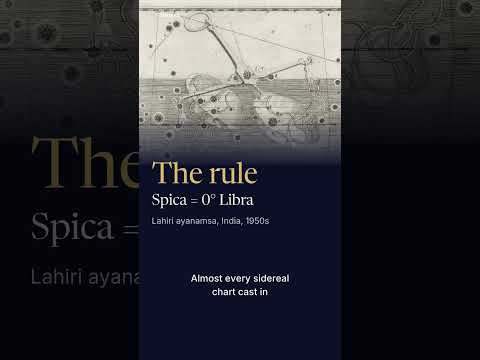
Spica, the star of Chitra (the 14th nakshatra), defines the Lahiri ayanamsa: it stands at exactly 0° sidereal Libra.
This video belongs with Chitra Nakshatra: Meaning, Deity, Traits and Padas, which has the full explanation and its classical sources.
The star in question
The clip explains why one bright star matters to nearly every Indian horoscope. Spica, the yogatara of Chitra, was fixed at the very start of sidereal Libra when the Lahiri ayanamsa became India's standard in the 1950s, so the sidereal zodiac in most almanacs is measured from it.
Why a zodiac needs an anchor
The tropical zodiac begins at the March equinox. Because the Earth's axis slowly wobbles (precession), the equinox drifts backwards against the stars by about 1° every 72 years. A sidereal zodiac stays with the stars instead, but then it needs a fixed starting point. The difference between the two zodiacs is the ayanamsa, now about 24°. Different ayanamsas, Lahiri, Raman, Krishnamurti and others, differ in where they place the start, by up to about a degree and a half.
The Lahiri decision
India's Calendar Reform Committee, chaired by the physicist Meghnad Saha, recommended in its 1955 report a sidereal zodiac in which Spica (α Virginis) sits at 180°, opposite the starting point. N. C. Lahiri, a member of the committee, gave his name to it, and it became the standard for the national ephemeris and most Indian almanacs. It is sometimes called the Chitrapaksha ayanamsa. Spica was a natural choice: a bright first-magnitude star close to the ecliptic, and traditionally the marker of the boundary between Virgo and Libra. Most software, including ours, uses Lahiri by default.
A worked example
A person has Venus at 29°30′ of Virgo by Lahiri. Venus is debilitated in Virgo, so a Lahiri reading would describe a self-critical, perfectionist Venus. With the Raman ayanamsa, which is smaller, the same Venus moves forward by more than a degree, to about 0°54′ of Libra, its own sign and moolatrikona. The two readings disagree completely. This is why astrologers who use different ayanamsas sometimes describe the same chart differently, and why it is worth asking which one was used.
Chitra itself
Chitra runs from 23°20′ Virgo to 6°40′ Libra. Its deity is Tvashtr, the divine craftsman, and its lord is Mars. It is associated with design, architecture, fashion, jewellery and any work that turns raw material into something beautiful.
Questions readers ask
Is Lahiri the "right" ayanamsa? It is the most widely used and an official standard; other schools have reasons for theirs. Does the ayanamsa change my Moon sign? Only if the Moon sits within a degree or so of a sign boundary.
Seeing Spica
Spica is easy to find. In the northern hemisphere, follow the curve of the Big Dipper's handle to the orange star Arcturus, then "speed on to Spica", a blue-white star low in the south on spring evenings. It is a close pair of hot stars orbiting each other in about four days, roughly 250 light-years away. In the southern hemisphere it rides higher in the sky. When the Moon passes near it, as it does once a month, the Moon is in Chitra.
A brief history of the debate
Before 1955 Indian almanacs used many ayanamsas, so the same festival could be dated differently in neighbouring regions. The committee's choice was partly scientific and partly practical: a single standard for a national calendar.
Why it matters to you
If your chart came from an Indian almanac or most Vedic software, it was almost certainly calculated with Lahiri. Knowing that helps when comparing charts from different sources.
Read and watch more
See Chitra and how we calculate. The long video Nakshatras 10–18: Magha to Jyeshtha covers Chitra and its neighbours.
Transcript
One star anchors the zodiac that most Vedic astrologers use. It is Spica, the star of Chitra, the fourteenth nakshatra. When India standardised the sidereal zodiac in the nineteen fifties, the Lahiri ayanamsa was defined so that Spica stands at exactly zero degrees Libra. Almost every sidereal chart cast in India today depends on that one star. Chitra means the bright one, and its symbol is a shining jewel.
Find your own Moon's nakshatra with a free kundli at sunyra.ai.
Astrology is a tradition of interpretation; read this as guidance, not a forecast. Disclaimer.