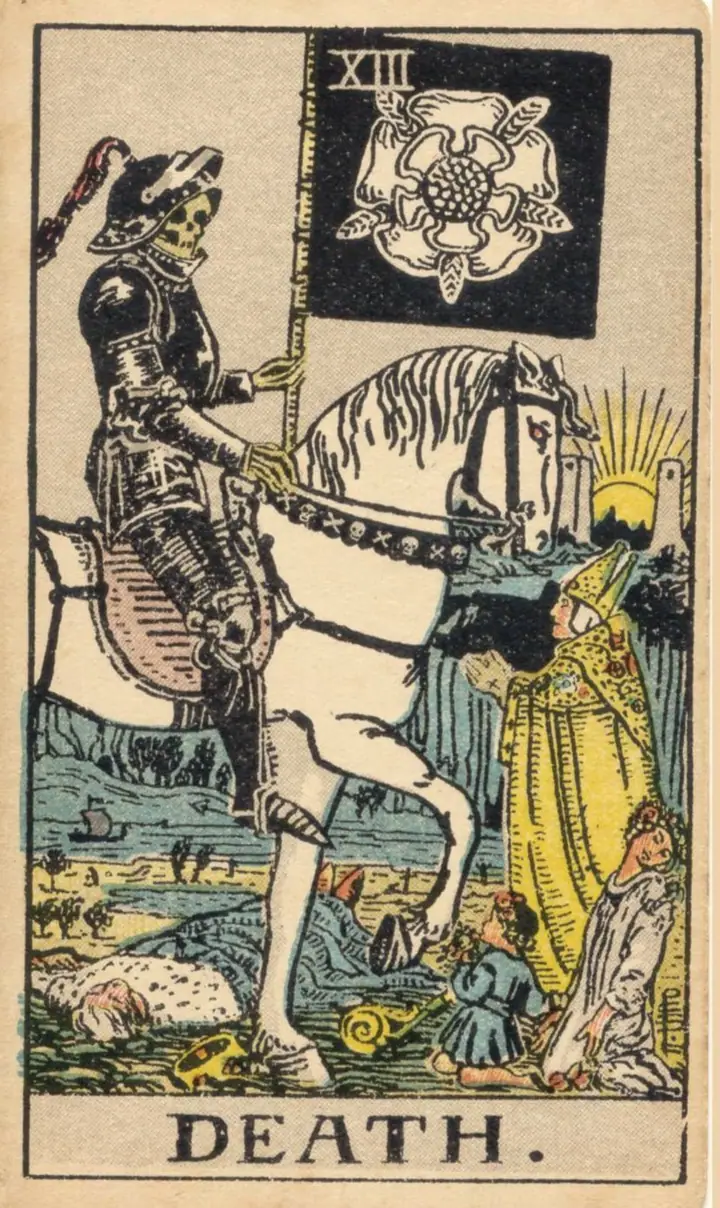

The picture on Death
A skeleton in black armour rides slowly forward on a white horse, carrying a black banner marked with a white five-petalled rose. Before him a king lies fallen, his crown on the ground. A bishop in gold stands with hands joined, facing him. A young woman turns her head away, and a small child looks up, unafraid, offering a flower. In the background a boat sails on a river, and between two towers on the horizon the sun is rising.
Every figure meets the rider differently, and that is the lesson of the card: endings come to everyone, and our response is what varies. The sunrise behind it all is easy to miss.
Number thirteen and Scorpio
Thirteen follows the completed cycle of twelve, which is why it is the number of the new beginning that only comes after an ending. The Golden Dawn assigned the card to Scorpio, the fixed water sign ruled by Mars, associated with depth, crisis, regeneration and what lies hidden. In Vedic astrology the eighth house, Scorpio's natural house, governs transformation, longevity and inheritance, and the Moon is debilitated in Scorpio because feeling there must go through intensity before it can rest.
Death upright
The card almost never refers to physical death, and no responsible reader uses it that way. Upright, it marks the end of a chapter: a job, a relationship, a home, a belief or an identity that has run its course. The ending may be chosen or arrive unbidden. Either way, the card says it is real and that holding on will cost more than letting go.
Its gift is clearing space. A field must be cut before it can be sown again. People who draw Death are often in a situation where something new is waiting but cannot arrive until there is room for it.
Death reversed
Reversed, the ending is being resisted. You may know a chapter is finished and keep turning back to reread it. Or the change is happening slowly, in a long, drawn-out way, because no one is willing to say it is over. The reversed card asks for courage: name what has ended, grieve it properly and turn toward what is next.
Death beside other cards
With the Tower, the change is sudden; with the Eight of Cups, it is a deliberate walking away. Next to the Star or the Sun, the sunrise in the background comes forward and the reading emphasises renewal. In love readings Death can describe the end of one phase of a relationship that allows a deeper one, not necessarily a break-up. In work readings it shows a role or field coming to its natural end.
Common misreadings of Death
Fear of this card comes mostly from films. Tarot readers in every serious tradition read it as transformation, not mortality. If anything, it is one of the more hopeful cards, because it confirms that a difficult chapter really is finishing and that something else can now begin.
Working with Death
Make a small ritual of closing: clear a drawer, return borrowed things, write a letter you do not send, mark the date. Endings that are acknowledged tend to finish cleanly. Then leave one week empty before filling the space, so you can notice what actually wants to grow there.
The card without a name
In the Tarot de Marseille the thirteenth trump usually carries a number but no title; French readers call it l'Arcane sans nom, the nameless arcanum, and the skeleton there walks on foot with a scythe, mowing a field in which heads and hands are sprouting. The Rider-Waite-Smith deck of 1909 gave the card its name and replaced the reaper with an armoured rider. The two images point to the same idea from different sides: the Marseille field shows a harvest that clears ground for new growth, the later card shows an arrival no rank can stop. Knowing both helps a reader present Death as change and clearing, never as a forecast about anyone's life.
A question from Death
What in your life is already over, and what would grow if you made room for it?