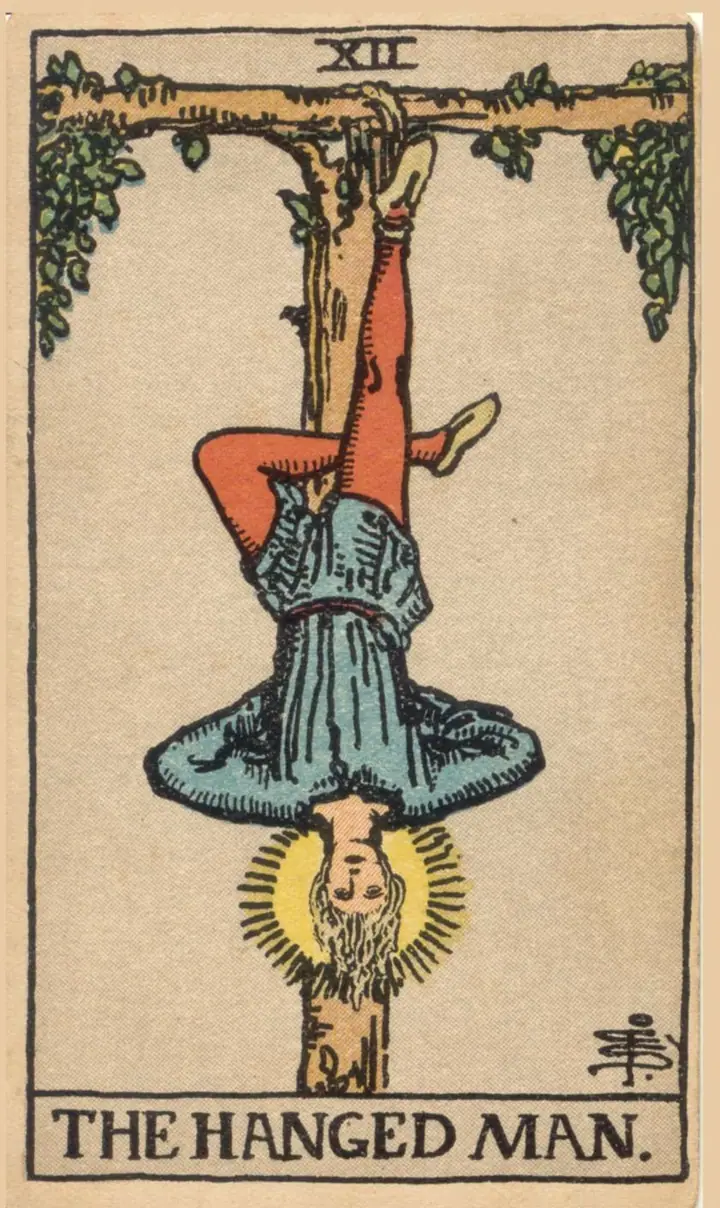

The picture on The Hanged Man
A young man hangs upside down by one foot from a T-shaped cross of living wood, the branches still in leaf. His free leg is bent behind the other to form a figure four; his hands are behind his back. He does not look distressed. His face is calm, almost serene, and a halo of yellow light surrounds his head. This is not a punishment scene. Whoever he is, he has chosen this position, or at least accepted it.
The card's paradox is that by stopping and turning upside down, he sees something no one standing upright can see.
Number twelve and water
Twelve is the number of the zodiac and of a complete cycle of months. The Golden Dawn gave the card to the element of water, and modern readers often associate it with Neptune: surrender, sacrifice, dissolution of the ego and spiritual insight. In Indian tradition the image echoes the ascetic who undertakes a hard vow, such as fasting, silence or stillness, to gain clarity. The suffering, if any, is in service of seeing.
The Hanged Man upright
Upright, the Hanged Man asks you to pause rather than push. Something is not moving, and more effort will not move it. A decision may need to wait, a negotiation may need time, or you may simply need to look at the situation from another side. The card often appears just before a change of perspective that makes the problem look quite different.
It can also describe a willing sacrifice: giving up short-term gain for long-term meaning, or letting go of the need to control an outcome. Its message is that waiting can be active, if the time is used to reflect.
The Hanged Man reversed
Reversed, the pause has become stagnation, or the sacrifice has turned into martyrdom. You may be hanging on long after the lesson has been learned, or giving up things no one asked you to give up. Sometimes it shows impatience: refusing to wait at all and forcing a decision too soon. Ask whether the delay is teaching you anything. If it is not, the time has come to come down.
The Hanged Man beside other cards
With the Four of Swords, the Hanged Man emphasises rest and recovery. With the Seven of Pentacles, it describes patient waiting for slow results. In relationship readings it can show a period of limbo, or a need to see the other person's point of view. In work readings it suggests that a delay is not a refusal, and that a different approach may unlock the matter.
Common misreadings of The Hanged Man
The Hanged Man is sometimes read as defeat or being stuck against your will. The calm face in the picture argues otherwise. This is a voluntary pause. When the card appears, the useful question is not 'how do I escape?' but 'what am I meant to notice while things are still?'
Working with The Hanged Man
Take the problem and deliberately argue the opposite of your current view for ten minutes, in writing. Then ask a person outside the situation how it looks to them. Turning the question upside down, as the man in the card has done, often shows a route you had walked past.
A question from The Hanged Man
What might you see if you stopped trying to fix this and simply looked at it from another angle?