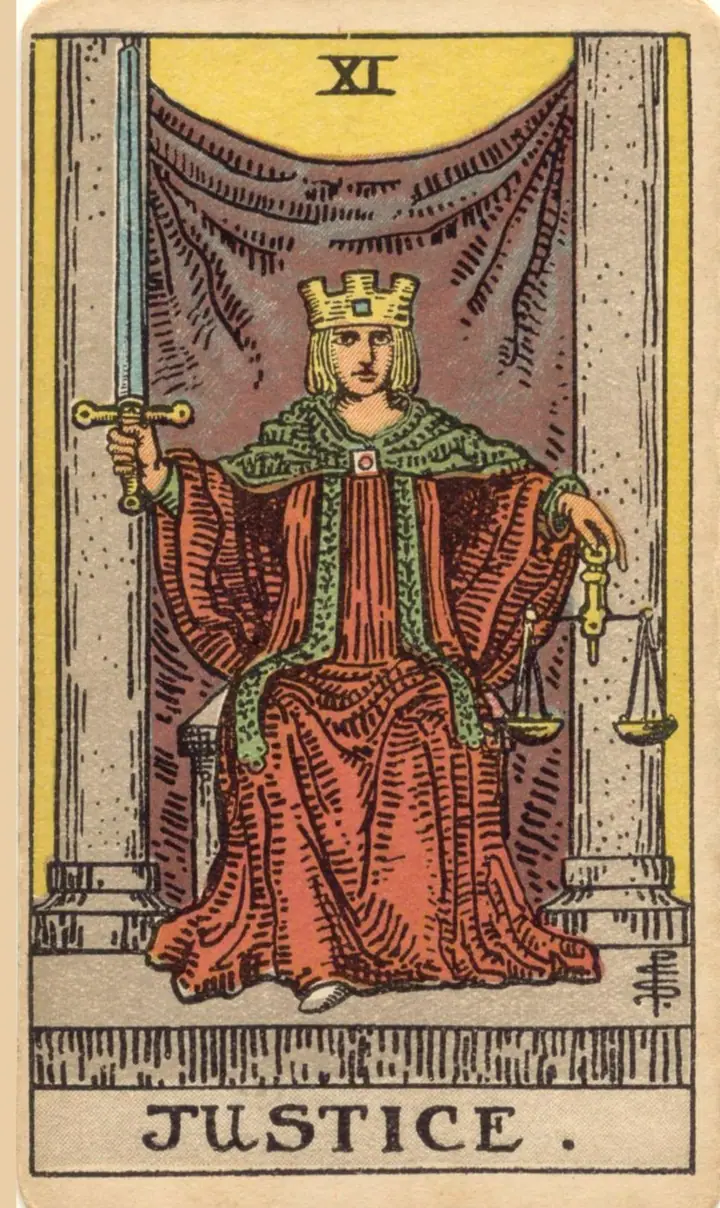

The picture on Justice
A crowned figure in a red robe and green cape sits upright between two grey pillars, a purple veil stretched behind. In the right hand is a double-edged sword pointing straight up; in the left, a pair of scales hanging perfectly level. One white shoe peeks out from beneath the robe. The eyes are open. Unlike many statues of Justice, this one is not blindfolded; she sees the case before her.
The image is simple on purpose. Weigh, then decide, then accept the result.
Number eleven and Libra
In Waite's order Justice is card eleven, swapped with Strength, and the Golden Dawn gave it to Libra, the sign of the scales, ruled by Venus. Libra seeks balance, fairness and the right relationship between parties. In Vedic astrology Tula is also the sign where Saturn is exalted, and Saturn is the planet of karma, duty and consequences. Both rulers suit the card: Venus for the wish for harmony, Saturn for the knowledge that every action has a weight.
Justice upright
Upright, Justice asks for honesty and fairness, beginning with yourself. It often appears around contracts, legal matters, official decisions, negotiations, and any situation where facts must be gathered and weighed. Its advice is to be accurate: get the paperwork right, state the facts plainly, and do not inflate or minimise your part.
It also says that results will reflect actions. If you have acted well, that tends to be recognised. If not, the card encourages you to take responsibility now, when correcting course still costs less. Justice is not punishment; it is the restoring of balance.
Justice reversed
Reversed, something is out of balance: a decision feels unfair, information is being withheld, or you are avoiding accountability. Sometimes it points to judging others harshly while excusing yourself, or the reverse, blaming yourself for things that were never yours to carry. Look for the missing fact and ask for it. If you are dealing with an official process, seek proper advice rather than assuming the worst.
Justice beside other cards
Beside the Hierophant or the Four of Pentacles, Justice may point to formal agreements, property or inheritance matters. With the Lovers, it asks that a relationship be fair to both people. In career readings it suits law, mediation, auditing, compliance, journalism and any role where truth matters more than charm. As an outcome, it suggests a balanced result: you will get what the facts support.
Common misreadings of Justice
Justice is not only about courts and lawsuits, although it often appears around formal processes. More commonly it describes everyday fairness: a fair share of housework, an honest invoice, a promise kept. It is also not the same as revenge; balance restored rarely feels like triumph.
Justice in the Marseille and Visconti-Sforza decks
Readers who learned on the Rider-Waite-Smith deck of 1909 are sometimes surprised to find Justice numbered VIII in the Tarot de Marseille. The older French pattern, printed by card-makers such as Nicolas Conver in 1760, places Justice eighth and La Force eleventh. Waite reversed them to fit the Golden Dawn's astrological sequence, which wanted Leo before Libra. Many Marseille readers keep the earlier order and see no loss in it, so a reading that leans on the number should say which tradition it follows.
The Marseille figure is stiffer and more frontal than Pamela Colman Smith's version. She sits on a throne wearing a crown, sword raised in one hand and scales held out in the other, and there is no purple curtain between pillars. The plain yellow background removes any sense of a private chamber; this is justice done in the open.
The fifteenth-century Visconti-Sforza cards, painted for the ruling families of Milan, add something that later decks dropped. Above the seated woman, in the gold background, an armoured knight gallops on a white horse with his sword drawn. Art historians often read him as a reminder that a ruler's justice was backed by force. In a modern reading that detail is worth borrowing: a fair decision still needs someone willing to carry it out.
Working with Justice
Write the situation down as a neutral observer would, in the third person, without adjectives. Then write the other party's view the same way. The exercise usually shows where your account was coloured, and it gives you a clear position to stand on in any conversation that follows.
Justice as a card of the day
Justice as a daily card favours paperwork, fairness and honest accounting. Settle what is owed, read contracts carefully, and make decisions you could explain to anyone.
A question from Justice
If someone fair-minded looked at every fact, what would they say you owe, and what is owed to you?