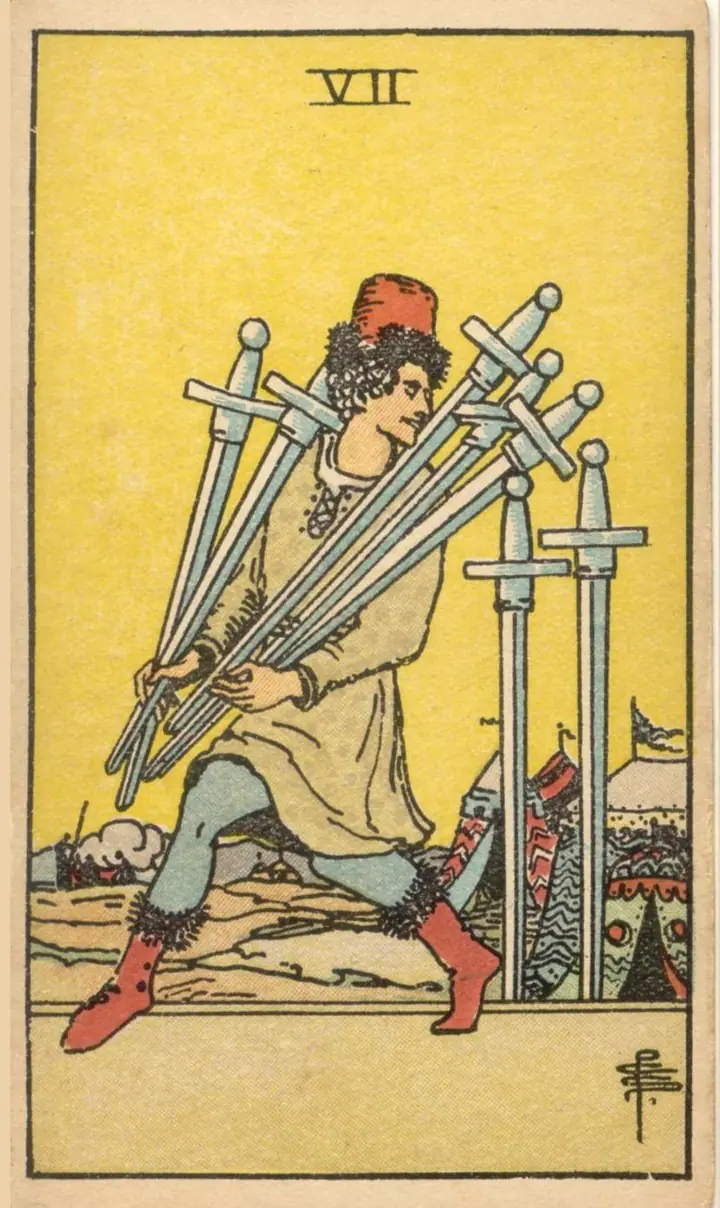

The scene on the Seven of Swords
A man in a red hat and boots tiptoes away from a military camp of colourful tents, carrying five swords bundled in his arms. He looks back over his shoulder with a sly half-smile. Two swords remain planted in the ground behind him. In the distance, near the tents, a small group of soldiers seems unaware of what is happening.
The card is about strategy and discretion, and sometimes about deception.
The Seven of Swords in the Golden Dawn scheme
The Golden Dawn named this card the Lord of Unstable Effort and gave it to the Moon in Aquarius, the last decan of the sign. The Moon's changeability meets Aquarius's independence and detachment, producing plans that are clever but uncertain. In Vedic astrology Chandra in Kumbha sits in Saturn's sign, which the Moon regards neutrally, and the placement is associated with an unconventional, sometimes aloof mind. The man in the card is acting alone and quietly, and his plan may not hold.
The Seven of Swords upright
Upright, the card describes acting strategically or secretly. Sometimes this is wise: you may need to keep plans to yourself, move quietly, or avoid open confrontation. But the card also warns of deception, by others or by yourself. Someone may not be telling the whole truth, or you may be cutting corners and hoping no one notices.
It asks you to examine motives. Discretion is one thing; dishonesty is another.
The Seven of Swords reversed
Reversed, secrets come out or a plan is abandoned. Someone may confess, or a deception may be discovered. Sometimes it shows conscience at work, deciding to come clean. The reversed card encourages honesty and transparency, which are usually less costly in the long run.
The Seven of Swords beside other cards
With the Moon, deception or confusion is strongly indicated. With the Five of Swords, conflict involves dishonesty. With Justice, truth will come to light. In love readings, the card can show secrecy in a relationship, or the need to protect your privacy. In work, it warns against office politics and cutting corners, but also supports discreet negotiation.
Common misreadings of Seven of Swords
The Seven of Swords is often read as theft or betrayal, and sometimes that fits. But the card also describes legitimate strategy: moving quietly, keeping plans private, taking only what one can carry. A negotiator who does not reveal their position, or someone leaving an unhealthy situation discreetly, can be the figure in the card. The real question is motive. Readers sometimes misread it as pointing at another person when it points at the querent's own shortcuts. The two swords left standing are a reminder that something has been left unfinished, and that clever exits often leave loose ends. Honesty, when it is possible, tends to cost less than the eventual discovery.
Working with the Seven of Swords
If you suspect someone is not being honest, gather facts before accusing. If you are keeping a secret, ask yourself whether it protects you or merely postpones a reckoning. Sometimes the best strategy is the open one.
Seven of Swords as a card of the day
The Seven of Swords as a card of the day advises discretion: keep plans private until they are ready, and check that you are not cutting corners. If something seems hidden, gather facts calmly before acting.
Seven of Swords in a yes-or-no question
In a yes-or-no question the Seven of Swords is usually a caution. It may be yes for a discreet, strategic move, but no for anything relying on concealment or shortcuts. Ask what would happen if everyone knew the full plan; if the answer is uncomfortable, the card is saying no.
A question from the Seven of Swords
Is what you are keeping quiet serving you, or are you hoping not to be noticed?