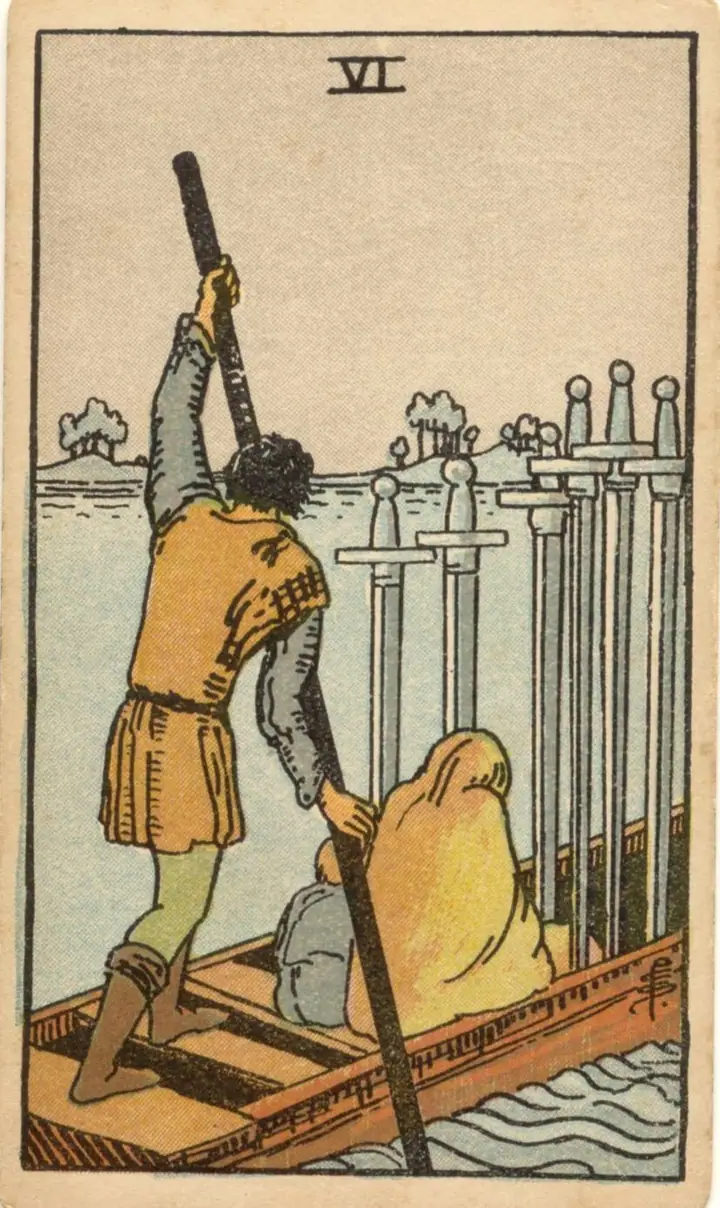

The scene on the Six of Swords
A ferryman stands at the back of a small boat, pushing it across the water with a long pole. In the boat sit a woman wrapped in a cloak and a small child huddled beside her. Six swords stand upright in the bow. On the right the water is choppy; on the left, where the boat is heading, it is smooth. In the distance lies a far shore with trees.
The card is about transition: moving away from trouble toward calmer waters.
The Six of Swords in the Golden Dawn scheme
The Golden Dawn called this card the Lord of Earned Success and gave it to Mercury in Aquarius, the middle decan of the sign. Mercury brings thought and travel; Aquarius brings detachment and a view of the future. Together they describe a reasoned decision to leave a difficult situation behind and move toward something better. In Vedic astrology Budha in Kumbha sits in the sign of Saturn, a planet Mercury regards as neutral, and the placement is often linked with practical, forward-looking thinking.
The Six of Swords upright
Upright, the card describes moving on. It may be a literal journey, a move to a new home or country, or an inner transition from a painful period to a calmer one. It is not a dramatic escape; it is a steady crossing, guided by someone or something reliable. The swords travel with the passengers: the past is not forgotten, but it is being carried somewhere it can rest.
The card offers reassurance: calmer days are ahead.
The Six of Swords reversed
Reversed, the crossing is delayed or difficult. You may be unable to leave a situation, or carry so much baggage that progress is slow. Sometimes it shows a return to troubled waters. The reversed card asks you to consider what is holding you back and what support you need to make the journey.
The Six of Swords beside other cards
With the Eight of Cups, leaving behind something unfulfilling is strongly indicated. With the World, travel or relocation is likely. With the Star, healing follows the transition. In love readings, the card can show a relationship moving through a difficult phase toward peace, or moving on after a break-up. In work, it favours relocation, job changes and steady progress after a challenging period.
Common misreadings of Six of Swords
Because the passengers look sad, the Six of Swords is sometimes read as loss. The direction of travel matters more: they are moving from rough water toward calm. It is a card of transition and recovery, often a literal move, a change of job or a change of heart after a difficult period. Another misreading is to treat the swords as left behind. They travel in the boat, upright: the past comes along, but it is being carried somewhere it can settle. The ferryman is easily overlooked. Most crossings require help, from a friend, a counsellor, a lawyer or a mentor. Asking who that ferryman is often makes the transition easier.
Working with the Six of Swords
Identify one practical step that would move you toward calmer waters: a phone call, a conversation, a booking, a decision. Take it this week. Also identify who is your ferryman, the person or resource that can help you make the crossing, and ask for their help.
Six of Swords as a card of the day
On a Six of Swords day, move toward calmer waters: travel, relocate a conversation, change a routine that keeps causing trouble. Accept help from a guide or friend. Progress is quiet but real.
Six of Swords in a yes-or-no question
The Six of Swords leans yes for moves, transitions and leaving difficulty behind; the way forward is calmer than the way back.
A question from the Six of Swords
What would calmer waters look like for you, and what is the first step toward them?