
The scene on the Five of Swords
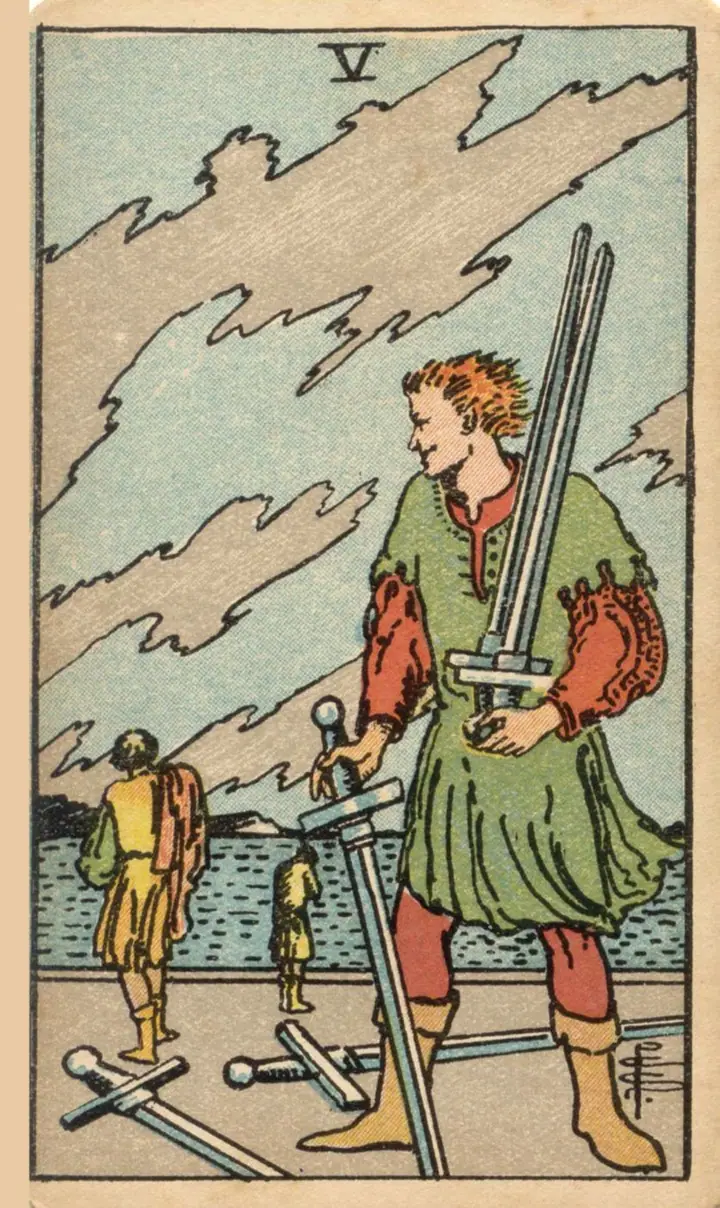
On a windswept shore under a jagged, broken sky, a young man with a sly smile gathers up swords. He holds three and two lie on the ground at his feet. In the background two other figures walk away, heads down, one with face in hands. The sea is grey and the clouds are torn. The man has won something, but the scene does not feel like a triumph.
The card is about conflict, and about victories that cost more than they gain.
The Five of Swords in the Golden Dawn scheme
The Golden Dawn named this card the Lord of Defeat and gave it to Venus in Aquarius, the first decan of the sign. Venus, planet of harmony and love, sits in a cool, detached air sign: relationships become intellectual, and when conflict arises, people may withdraw rather than reconcile. In Vedic astrology Venus in Kumbha sits in the sign of its friend Saturn, but the placement is often associated with emotional detachment. The defeat here is the loss of connection, not just of the argument.
The Five of Swords upright
Upright, the card describes conflict in which someone wins at others' expense. You may be the winner, the loser or a bystander. The card asks whether the victory is worth it. Winning an argument but losing a friend, gaining a point but damaging trust: these are the kinds of outcomes it warns against.
It can also describe dishonesty, manipulation or a situation where the rules are being bent.
The Five of Swords reversed
Reversed, the conflict ends or is reconsidered. Someone may apologise, or both sides may agree to move on. Sometimes the reversed card shows lingering resentment after a defeat. The reversed card encourages reconciliation, if it is genuine, and letting go of the need to win.
The Five of Swords beside other cards
With the Five of Wands, competition turns bitter. With the Seven of Swords, deception is a factor. With Justice, fairness must be restored. In love readings, the card can describe arguments that leave both people hurt, or a relationship where one person always needs to win. In work, it warns against office politics and advises choosing your battles carefully.
Common misreadings of Five of Swords
The Five of Swords is sometimes read simply as losing. The figure in the foreground, gathering the swords, has won; it is the two walking away who lost. Yet the card is rarely encouraging for the winner either. A victory that leaves everyone else alienated is the theme. People also misread it as advice to give up whenever conflict appears. The card is more specific: choose battles worth fighting, fight them fairly, and consider the relationships that will remain after the argument. In workplaces it often describes office politics, where small wins cost long-term trust. The healthiest response is usually to ask what each side actually needs and whether a fairer settlement exists.
Working with the Five of Swords
Before the next argument, ask yourself: what do I actually want from this? If the answer is to be right, consider whether that is worth the cost. If you have already won a hollow victory, consider an apology or a gesture of goodwill. If you were defeated, take what lesson you can and walk on.
Five of Swords as a card of the day
As a daily card the Five of Swords warns against winning at any cost. Choose which battles matter, and let small points go. If you have been on the losing side of a disagreement, walk away with dignity and learn what you can.
A question from the Five of Swords
Is the battle you are fighting worth what it might cost you in trust and goodwill?