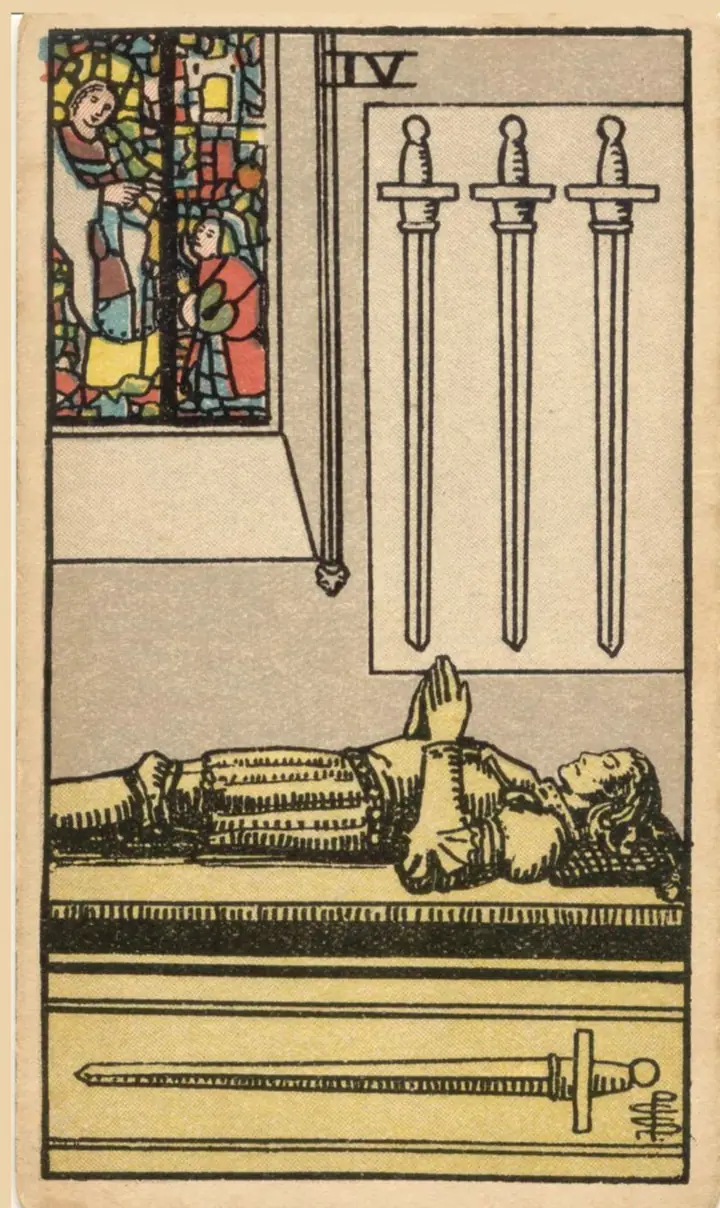

The scene on the Four of Swords
Inside a church, a knight lies on his back on a stone tomb, his hands pressed together in prayer over his chest. He is carved in effigy, perhaps asleep, perhaps a memorial. Three swords hang on the wall above him, points down; a fourth lies horizontally along the side of the tomb beneath him. Behind him a stained-glass window shows a figure kneeling before another, with the word PAX, peace, visible in some printings.
The card is about rest, recovery and contemplation after struggle.
The Four of Swords in the Golden Dawn scheme
The Golden Dawn named this card the Lord of Rest from Strife and assigned it to Jupiter in Libra, the last decan of the sign. Jupiter brings grace and healing; Libra brings balance. Together they describe a necessary pause, a truce that allows recovery. In Vedic astrology Guru in Tula sits in the sign of Venus, whom Jupiter regards as an enemy, which hints that this rest is not luxurious; it is a disciplined, sometimes reluctant retreat that does real good.
The Four of Swords upright
Upright, the card calls for rest. After stress, illness, conflict or overwork, the mind and body need time to recover. It favours sleep, retreat, meditation, convalescence and quiet planning. The swords are hung up, not abandoned: you will pick them up again later, refreshed.
It also suggests reflection. Before the next challenge, take time to consider what you have learned and what you want to do differently.
The Four of Swords reversed
Reversed, rest is resisted or comes to an end. You may be pushing on when you need to stop, or returning to activity after a long break. Sometimes it shows restlessness during a period of enforced inactivity. The reversed card asks you to respect your limits, and to return gradually rather than all at once.
The Four of Swords beside other cards
With the Hermit, retreat and reflection are strongly emphasised. With the Ten of Wands, burnout is a real risk and rest is urgent. With the Six of Swords, recovery leads to a move toward calmer conditions. In love readings, the card can show a pause in a relationship, a break to reflect, or simply the need for quiet time together. In work, it supports holidays, sabbaticals and stepping back from conflict.
Common misreadings of Four of Swords
The effigy on the tomb leads some readers to treat the Four of Swords as illness or death. Most traditions read it as rest: a knight laid down after battle, sword hung up, waiting to rise. It is one of the most protective cards in the suit. The other misreading is guilt, treating rest as laziness. In many readings this card is direct advice to stop, sleep, take leave or step away from a conflict before making the next move. For students, carers and workers under heavy pressure it often appears just before burnout, which makes it practical rather than mystical. The stained-glass window behind the knight hints that quiet reflection, not only sleep, is part of the remedy.
Working with the Four of Swords
Schedule genuine rest, not a few minutes between tasks, but a real block of time without obligations. Turn off notifications. Sleep, walk slowly, sit in a quiet place. If you are recovering from illness, follow medical advice and do not rush back. The swords will still be there when you return.
Four of Swords as a card of the day
On a Four of Swords day, rest is the task. Sleep, take a break, step away from conflict and plan quietly. If you cannot take the day off, protect at least an hour of stillness. Decisions made after rest will be better.
A question from the Four of Swords
What would happen if you allowed yourself to rest fully, without guilt, for a while?