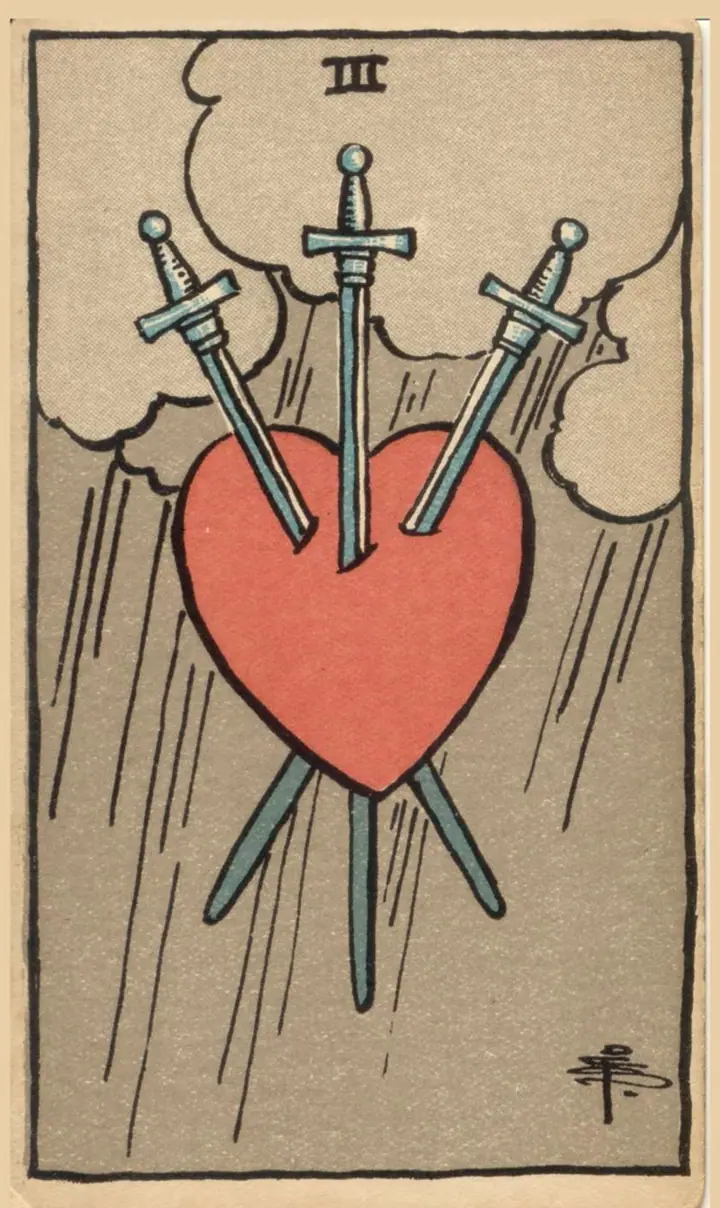

The scene on the Three of Swords
Against a grey, stormy sky with rain falling in slanting lines, a large red heart floats in the air. Three swords pierce it, one straight down through the centre and two at angles from either side. There are no people in the picture, no landscape, nothing but the heart, the swords and the weather. It is one of the most direct images in the deck.
The card is about heartache: pain caused by words, truth, loss or separation.
The Three of Swords in the Golden Dawn scheme
The Golden Dawn called this card the Lord of Sorrow and gave it to Saturn in Libra, the middle decan of the sign. Saturn is exalted in Libra in both Western and Vedic astrology, which might seem strange for a card of grief. But Saturn's exaltation is about justice, duty and facing hard truths, and Libra is the sign of relationships. Together they describe the pain of seeing a relationship clearly, of truth that must be faced. Saturn's sorrow is sober and ultimately strengthening.
The Three of Swords upright
Upright, the card describes emotional pain: heartbreak, betrayal, grief, rejection, or hurtful words. It may follow a break-up, a painful discovery, or a loss. The card does not soften this. It acknowledges the pain as real and the tears as appropriate.
What it does offer is the reminder that rain passes. The storm in the picture will move on. Pain faced honestly tends to heal more cleanly than pain avoided.
The Three of Swords reversed
Reversed, healing begins. The swords are being removed, forgiveness becomes possible, and the heart starts to recover. Sometimes it shows grief that has been suppressed and needs to be expressed. The reversed card encourages you to allow sadness, talk with someone you trust, and give recovery its own time.
The Three of Swords beside other cards
With the Five of Cups, the grief is strong and centred on loss. With the Ten of Swords, a painful ending is complete. With the Star or Temperance, healing follows. In love readings, the card can describe heartbreak, but also a painful truth that leads to a more honest relationship. In work, it may describe disappointment or harsh criticism that, once absorbed, leads to improvement.
Common misreadings of Three of Swords
Because the image is so stark, the Three of Swords is easily read as catastrophe. It describes pain, but pain of a specific kind: the clean hurt of a truth that cannot be unknown, or a loss that has already happened. It does not predict new disasters. Readers also tend to forget the rain. Storms pass, and grief that is felt honestly tends to move more quickly than grief that is avoided. Another misreading assigns blame automatically to a third party. The swords may be one's own words, a misunderstanding, or simply circumstances. The card is less about who wounded whom than about acknowledging the wound so that it can heal.
Working with the Three of Swords
Allow yourself to grieve. Write, cry, talk, walk. Do not rush to replace what was lost. When you are ready, write down what this pain has taught you about what you need and deserve. That lesson is the first step toward a healed heart.
Three of Swords as a card of the day
The Three of Swords as a daily card asks for gentleness with whatever hurts. Allow sadness its time, talk to someone you trust, and avoid sharp words that would add another sword. Painful news, if it comes, is usually clarifying in the long run.
Three of Swords in a yes-or-no question
In a yes-or-no question the Three of Swords usually signals no, or a yes that will involve some pain: an honest conversation, an ending, a truth that has to be faced. It rarely means disaster; it means the answer will hurt before it helps.
A question from the Three of Swords
What would it mean to let yourself feel this fully, trusting that the storm will pass?