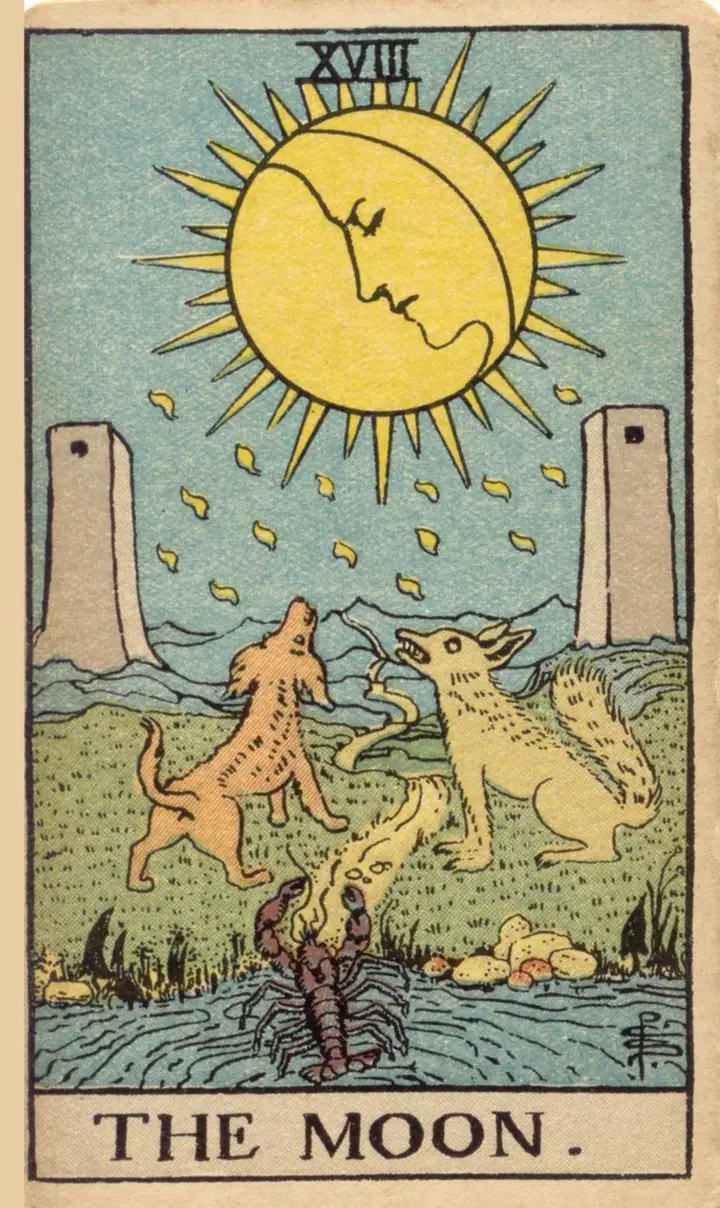

The picture on The Moon
A full moon with a sorrowful face, overlaid on a crescent, shines between two grey towers. Drops of light fall from it like dew. On either side of a winding path, a domestic dog and a wild wolf howl up at it. From a pool in the foreground a crayfish crawls onto the land. The path climbs between the towers toward distant hills, but it is long, and the light is uncertain.
The Moon is a card of half-light: you can see shapes, but not clearly, and your instincts are as loud as your reason.
Number eighteen and Pisces
Eighteen reduces to nine, the Hermit's number, but where the Hermit carries his own lamp, the traveller here has only reflected light. The Golden Dawn gave the card to Pisces, the mutable water sign ruled by Jupiter, sign of dreams, imagination, compassion and confusion. In Vedic astrology Meena is also the sign of moksha, of dissolving boundaries, and Venus is exalted there. The card holds Pisces' beauty and its fog together.
The Moon upright
Upright, the Moon advises caution with conclusions. Something is unclear, possibly because information is missing, possibly because anxiety or wishful thinking is colouring what you see. It is not the time to sign, decide or accuse. Wait for more light, check the facts and notice how much of your reading of the situation is fear.
The card also honours dreams, creativity and intuition. Artists, poets and healers often meet the Moon kindly. The crayfish rising from the pool is an image of something from deep inside coming to the surface, and that can be a gift, if you are patient with it.
The Moon reversed
Reversed, the fog begins to lift. A misunderstanding is cleared up, a fear is shown to be smaller than it seemed, or a deception comes to light. Sometimes the reversed Moon describes the opposite problem: refusing to look at feelings at all, keeping everything rational to avoid the uncomfortable parts. Either way, the remedy is to bring what is hidden into the open, gently.
The Moon beside other cards
With the High Priestess, the Moon intensifies intuition and dreams. With the Seven of Swords, it warns that someone may not be telling the whole story. In love readings it can describe uncertainty about another person's feelings, and suggests asking rather than guessing. In work it advises reading contracts carefully and clarifying any vague arrangement.
Common misreadings of The Moon
The Moon is sometimes read as a warning of betrayal. Occasionally deception is involved, but more often the confusion is innocent: missing information, tired minds, or old fears projected onto a new situation. Assume uncertainty rather than malice until the facts show otherwise.
The Moon in the Tarot de Marseille
In the Marseille pattern, card XVIII, La Lune, shows the moon in profile, a face drawn inside a crescent, with long rays around it. Instead of a dog and a wolf there are usually two dogs, in many editions coloured alike, facing each other with open mouths. Between them stand two small towers, and in the foreground a large blue crayfish rests in a rectangular pool. The droplets in the air are drawn as if they rise up toward the moon rather than fall from it, and some readers take that as the earth giving something back.
Pamela Colman Smith followed Waite's notes when she made one of the animals a wolf. The change sharpens a contrast that the older card leaves implicit: tame instinct against wild instinct, the house dog against the creature of the woods. In Marseille readings the two dogs are more often read as twin anxieties, or as two people barking the same alarm at each other.
A practical tip follows from the comparison. When the Moon turns up in a reading, ask which version of the picture fits. If the situation feels like a clash between a sensible voice and a wild one, the 1909 image speaks. If it feels like two worried voices amplifying each other, as in a late-night argument or a group chat spiralling, the two dogs of the Marseille card describe it better.
Working with The Moon
Separate what you know from what you fear. Draw two columns and be strict: only verifiable facts go in the first. Often the second column is long and the first is short. Then decide what one question, asked of the right person, would move something from fear into fact.
The Moon as a card of the day
As a card of the day, the Moon advises against firm conclusions. Postpone signing and accusing; gather facts, note dreams and intuitions, and wait for clearer light. Creative work goes well under this card.
The Moon in a yes-or-no question
The Moon in a yes-or-no question is usually 'not clear yet'. Wait for more information before deciding. If you must decide, choose the option that keeps the most doors open.
A question from The Moon
Which of your current worries are based on facts, and which are shapes in the moonlight?