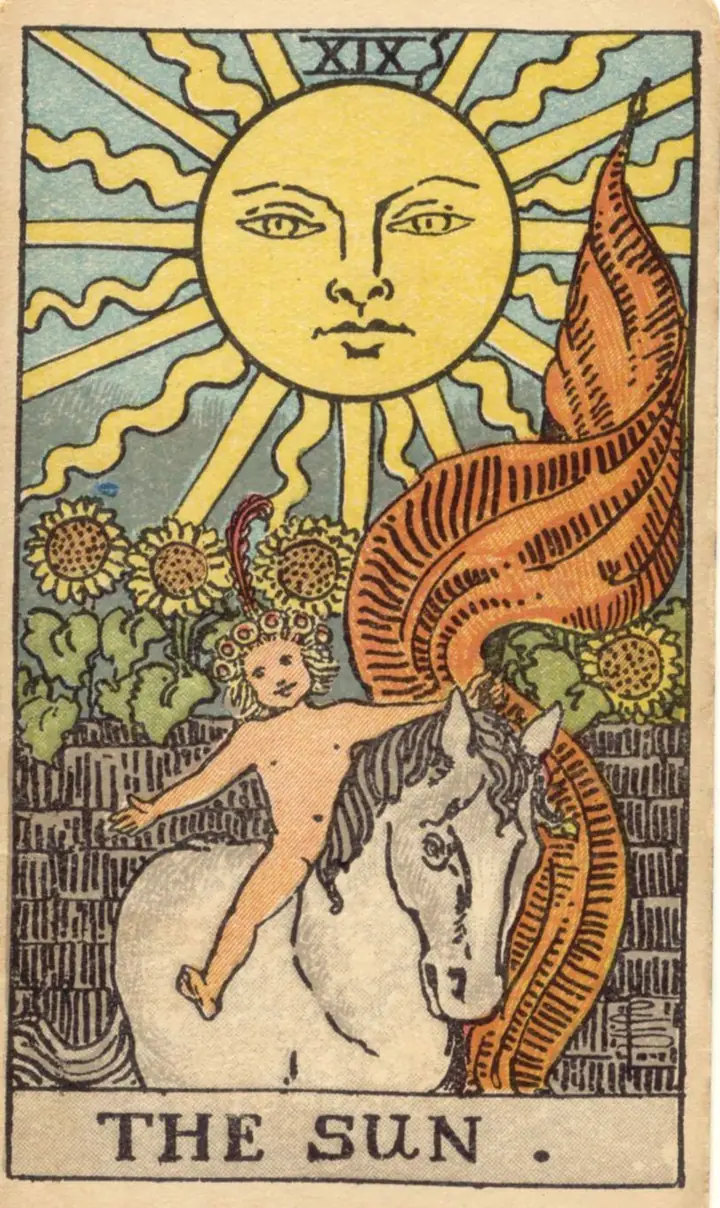

The picture on The Sun
A huge golden sun with a human face blazes in a clear blue sky, its rays alternating straight and wavy. Below, a naked child with a garland of flowers and a red feather in its hair rides a white horse bareback, arms flung wide, holding a long red banner. Behind them a grey wall is crowned with tall sunflowers, all turned toward the child rather than toward the sun. There is no shadow anywhere in the picture.
After the uncertainty of the Moon, this is the clearest card in the deck. Everything is visible, and nothing needs hiding.
Number nineteen and the Sun
Nineteen reduces to ten and then to one: the Wheel and the Magician, a cycle completed and a new act of will. The Golden Dawn gave the card, naturally, to the Sun. In Vedic astrology Surya is the soul, the father, vitality, authority and self-confidence, the king of the planets. A strong Sun in a horoscope gives clarity and dignity; the Sun card shows that quality in its most joyful form, without the weight of the throne.
The Sun upright
Upright, the Sun is a straightforward yes. It speaks of success, good health, warmth in relationships, happy family occasions and things going well because they are being done openly. It favours putting your work forward, applying for the role, travelling, celebrating and letting yourself be seen.
The child on the horse is important. The card's joy is not sophisticated; it is the simple, physical gladness of being alive on a good day. It asks you to notice that gladness when it comes and to share it.
The Sun reversed
Reversed, the sun is behind clouds rather than gone. Success may be delayed, enthusiasm a little dimmed, or confidence tipped into arrogance. Sometimes it points to happiness that is present but not being felt, because attention is fixed on what is missing. The correction is often as simple as stepping outside, literally, and doing something with no purpose but enjoyment.
The Sun beside other cards
With the Wheel of Fortune or the World, the Sun forms some of the most positive combinations in tarot. With the Six of Wands, it brings public recognition. In love readings it describes warmth, openness and happiness, and in some traditions children or a happy family occasion. In work it favours leadership, education, performance and anything done in public view. Even next to hard cards, the Sun tends to soften the reading.
Common misreadings of The Sun
Few misread the Sun as negative, but people sometimes take it as a guarantee that requires no effort. The child on the horse has still had to climb on and ride. The card describes favourable conditions, which are best met with action, generosity and gratitude rather than complacency.
Working with The Sun
Spend time in daylight each morning for a week and notice its effect on mood and sleep. Make one thing you have been working on visible to others, such as sharing it, publishing it or presenting it. The Sun rewards openness, and things grow faster when they are exposed to light.
The Sun as a card of the day
On a Sun day, be visible and generous. Share good news, spend time outdoors, and enjoy simple pleasures with children or friends. Openness is rewarded.
Two children and one
Older decks such as the Tarot de Marseille show the Sun shining over two children, often read as twins, standing together before a low wall. The Rider-Waite-Smith card of 1909 replaced them with a single naked child riding a white horse, holding a red banner, with sunflowers along the wall behind. The change shifts the meaning slightly. The twins speak of friendship, partnership and being seen by someone who knows you; the lone rider speaks of confidence, play and being comfortable in your own skin. Readers often use whichever image fits the question, and the Sun drawn about a relationship can carry the older sense of two people in the same light.
A question from The Sun
What is going well right now that you have not paused to enjoy?